Payments is one of the few security niches with credentials written for it, all from the PCI Security Standards Council: the open PCI Professional (PCIP), the employer-sponsored Internal Security Assessor (ISA) and the Qualified Security Assessor (QSA), which demands both a security and an audit certification first. Beyond card data, regulators and bank partners set the agenda for fintech security, and general certifications cover that part.
What the job looks like at a fintech
Think of a fintech as a cloud-hosted software company that touches regulated money. That gives its security team three jobs at once. Card data, if the company stores, processes or transmits it, brings PCI DSS and an annual assessment. Partner banks and regulators send due diligence questionnaires and examine controls, and in some places the law names specific requirements. And the product itself, often a mobile app and a set of public APIs, needs the application security any software company needs, with fraud and account takeover near the top of the threat list.
At a small fintech one person may cover all three, which is why the certification path below branches late.
The PCI credentials, side by side
The Council lists more than a dozen training and qualification programs, most for specialized assessors of PIN security, point-to-point encryption or card production. Three matter for most fintech careers.
PCIP is the open one. The Council describes it as an entry-level, renewable credential for people in security, compliance, audit or payments product roles. The exam is 75 multiple-choice questions in 90 minutes, and you need 75% to pass. Training and exam together cost $2,750 for people whose employer isn't a Council participating organization, rising to $3,000 on January 1, 2027, according to the PCIP page. It's valid for three years, with 10 CPE hours a year and 30 over the three-year period.
ISA is for internal staff who assess their own company's PCI DSS compliance. Candidates "must be sponsored by their employer", the Council recommends at least five years of security audit and assessment experience, and ISAs re-qualify every 12 months. The qualification belongs to the sponsoring company's program, so plan on it not following you if you move.
QSA is the external assessor role. A QSA must be a full-time employee of a QSA company and needs at least one year of experience in each of application security, information systems security, network security, IT security auditing and risk assessment or management. The Council also requires one information security certification from its List A (such as CISSP or CISM) and one audit certification from List B (such as CISA, GIAC's GSNA or an ISO 27001 auditor certification), and QSAs re-qualify every 12 months. That pairing rule is the most concrete reason in this field to hold both a security and an audit credential.
The standard behind all three is PCI DSS v4.x. The 51 requirements that v4.0 marked as future-dated became mandatory on March 31, 2025, so every assessment now tests the full set. Our PCI DSS guide covers the standard itself.
The regulations that set the agenda
Outside card data, two rule sets shape a lot of fintech security work.
In the EU, the Digital Operational Resilience Act (DORA, Regulation (EU) 2022/2554) has applied since January 17, 2025 to 20 types of financial entity, according to the European Insurance and Occupational Pensions Authority (EIOPA), and to ICT providers that serve them. Its five areas are ICT risk management, incident reporting, resilience testing including threat-led penetration testing, third-party risk, and oversight of critical ICT providers. A fintech selling to EU banks will feel DORA through contract clauses even if it isn't in scope itself.
In New York, the Department of Financial Services' cybersecurity regulation, 23 NYCRR Part 500, applies to any business operating under a license, registration, charter or similar authorization under New York's Banking, Insurance or Financial Services Law. Its second amendment took effect on November 1, 2023, and its last phased requirements, multi-factor authentication for anyone accessing the entity's information systems and a documented asset inventory, applied from November 1, 2025. Part 500 also requires each covered entity to designate a CISO, who may be employed by an affiliate or a third-party service provider, although entities small enough for its limited exemption (fewer than 20 employees and contractors, for example) are excused from that section.
Neither rule names a certification; both describe work that the general certifications cover.
A staged path
- Getting in: a baseline such as Security+, plus a cloud certification on the platform your target employers run. At a fintech, cloud is where the controls are.
- First specialty: PCIP if you'll own PCI scope, or AWS Certified Security - Specialty if you'll build the controls in AWS. An engineer who owns PCI scope in AWS will want both in time.
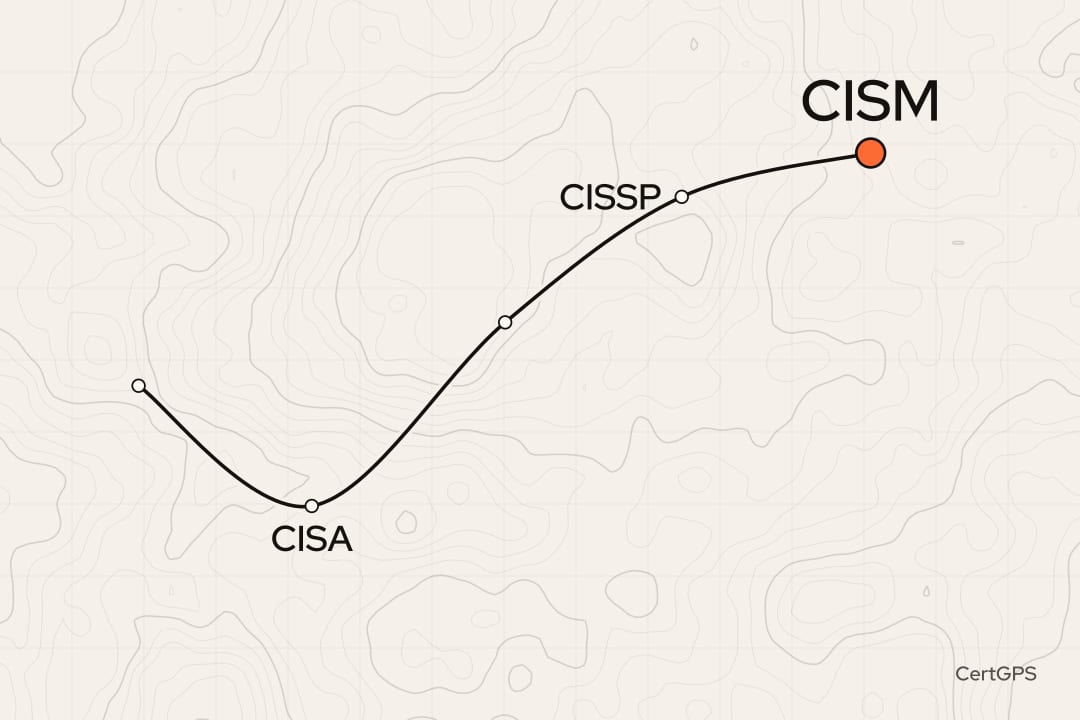
- Assurance track: CISA is ISACA's audit credential and counts on the QSA List B. Pair it with CISSP or CISM for List A if a QSA firm is a possible next employer. ISA comes when an employer sponsors you.
- Engineering track: CSSLP for secure design across the software lifecycle, or an offensive web credential such as OSWE if you're testing your own APIs.
- Risk and leadership: CRISC for the person who runs the risk register and answers bank partners' questionnaires, then CISM or CISSP if you're heading for the CISO role that Part 500 requires covered entities to fill.
The experience rules decide the timing more than study does. CISSP needs five years, CISA five (ISACA waives up to three), CRISC three years in both risk assessment and risk response with no waivers. Our finance security guide covers banks and insurers, where the same certifications appear with more weight on audit.
Our view
PCIP is easy to dismiss as a training-course credential, and at the Council's $2,750 list price it isn't cheap. We'd still take it early if you own PCI scope, because it puts you through the standard line by line, and its 90-minute exam is far shorter than the three or four hours ISC2 and ISACA set. For long-term value, though, the decision that matters is CISA plus CISSP or CISM. That pair opens the QSA route, is the pairing we'd expect a bank partner's reviewer to recognize, and it carries over to any regulated industry if you leave payments.
Sources (15)
- PCI SSC: Training and qualification programs: list of individual programs, checked October 2026
- PCI SSC: PCI Professional (PCIP): audience, 75 questions, 90 minutes, 75% pass, price and January 1, 2027 increase, three-year validity, CPE rule, checked October 2026
- PCI SSC: Internal Security Assessor: sponsorship, recommended experience, annual re-qualification, checked October 2026
- PCI SSC: QSA qualification: employment, experience, List A and List B certifications in full, annual re-qualification, checked October 2026
- PCI SSC blog: future-dated requirements of PCI DSS v4.x: 51 future-dated requirements effective March 31, 2025, checked October 2026
- EIOPA: Digital Operational Resilience Act: regulation number, January 17, 2025 application, five areas, entity types, checked October 2026
- NYDFS: 23 NYCRR Part 500, second amendment text (PDF): November 1, 2023 effective date, two-year transition for sections 500.12 and 500.13(a), CISO designation, section 500.19(a) limited exemption, checked October 2026
- CompTIA Security+ V7: baseline certification, checked October 2026
- AWS Certified Security - Specialty: scope, checked October 2026
- ISACA Support: requirements to become CISA certified: five-year experience rule and waivers, checked October 2026
- ISACA Support: requirements to become CRISC certified: experience rule, checked October 2026
- ISACA: CISM certification: audience, checked October 2026
- ISC2: CISSP: five-year experience requirement, checked October 2026
- ISC2: CSSLP: scope, checked October 2026
- OffSec WEB-300: OSWE scope, checked October 2026