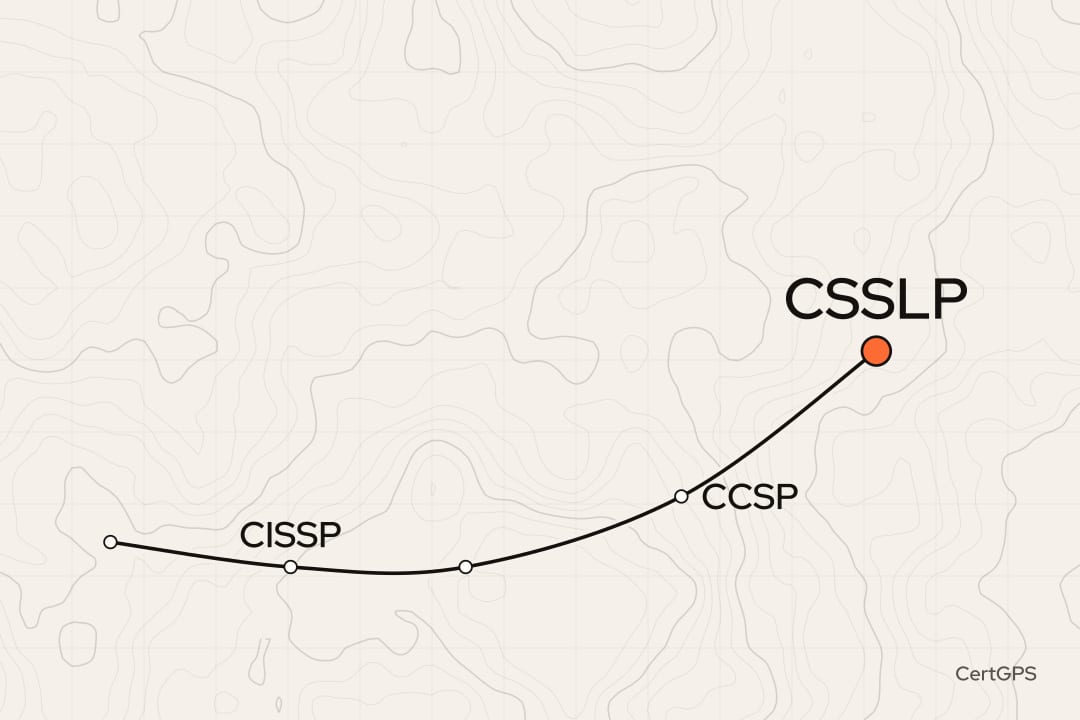
Security architecture becomes useful when a team can act on the design and understand its tradeoffs. Choose a specialization by the systems you can explain: cloud infrastructure, software products or broader enterprise services. A general credential can organize the breadth, but the next stage needs evidence that you can carry a design from a requirement through implementation and review.
Begin with a decision you have helped make
Use the NICE Workforce Framework's cybersecurity architecture role to identify the work behind the title. Architecture includes relating security needs to system design; it is not simply drawing a network diagram. Start with a decision such as how a service authenticates a caller, where administrative authority sits or how a system recovers after a failure.
Describe the requirement, the constraints and the alternatives. If you have never participated in those discussions, seek a bounded design responsibility within your current role. An operator can review privileged access; a developer can own the security design of a feature. The aim is to learn how the organization approves and implements a decision.
Keep a record of what happened after the design review. Which assumption proved wrong? Which control needed adjustment? A specialization becomes credible when your knowledge includes the operational consequences of the design, not only the diagram that was approved.
Build breadth with CISSP when your experience supports it
CISSP covers security across risk, architecture, operations and other domains. ISC2 requires qualifying professional experience for the full credential. Passing the exam before completing that requirement can lead to an Associate of ISC2 route, subject to its rules; it does not make the candidate a certified CISSP.
Read the experience requirements alongside your work history. Identify the tasks you actually performed and who can verify them. Do not assume that a job title automatically supplies every required domain, or that several qualifying credentials can be stacked to remove several experience years. ISC2 limits the applicable waiver.
Use the syllabus to improve how you frame a decision. A storage design, for example, needs more than an encryption choice: identity, recovery, ownership and assessment also matter. The exam can help organize those questions. Your design evidence should show how you answer them for a particular system.
Specialize in cloud through responsibility boundaries
CCSP fits a route focused on cloud security. Its usefulness comes from the relationship between architecture, data, operations and provider responsibilities. ISC2 applies a professional experience requirement, with a full waiver for holders of an active CISSP under its current rules.
Learn a cloud platform deeply enough to build and troubleshoot the controls you recommend. Produce a design with service identities, administrative access and observable deployment behavior. Identify the controls the provider operates and those your team must configure. Avoid describing a managed service as a transfer of every security obligation.
Test the failure paths. Show what happens when a deployment receives too much privilege, when a logging dependency is unavailable or when an operator needs emergency access. These are suggested design exercises, not a universal cloud architecture checklist. The cloud security career route develops the related operational skills.
Take the software route through requirements and change
CSSLP is relevant when you work across secure software requirements, design, implementation and verification. It suits an architect who must help developers deliver a feature securely and preserve the protection as the product changes. It is not a substitute for reading code or understanding the development process of the actual team.
Use NIST's Secure Software Development Framework as a reference when examining that process. Choose a feature, identify the security requirement and trace it through the implementation, tests and release evidence. Explain how the team would recognize a later change that breaks the original assumption.
Practise reviewing a design without turning every concern into an unowned recommendation. If a proposed control requires a product decision, state who must make it. If the engineering team chooses an alternative, record why it meets the requirement or what residual risk remains. That record is more useful than an architecture diagram nobody can maintain.
Keep management and architecture responsibilities distinct
CISM is relevant when your role expands into security governance and program management. It requires management experience for the full credential. Choosing it should follow that responsibility, rather than an assumption that every senior architect must collect a management badge.
An architect may explain a technical risk while a business owner accepts it. A security manager may set program priorities while an engineering owner controls a release. Learn the decision boundaries in your organization and state them clearly in a review. A credential does not confer authority that the organization has not delegated.
For broader systems thinking, NIST SP 800-160 Volume 1 Revision 1 describes engineering trustworthy secure systems. Read it as an engineering reference, not an exam product. Use the concepts to ask how assurance is supported throughout a system's lifecycle and what evidence is missing at a particular decision point.
Make your specialization legible in an interview
Prepare a small set of connected artifacts: the requirement, the design decision and the evidence from implementation or testing. Use synthetic or approved information. Explain what the design covers, what it assumes and which responsibilities remain outside your role. Do not publish confidential architecture to prove that you worked on a significant system.
Compare the next credential with the gaps revealed by that discussion. If the interviewer needs platform depth, a general management exam may add little. If the gap is connecting controls to program priorities, another narrow product exam may not help. The multi-certification strategy provides a way to make that choice explicit.
A workable sequence is to establish operational or development competence, take on a bounded design responsibility and then broaden the scope. Advance when you can explain what the design accomplishes and how its assumptions are checked after release. No published universal timetable makes a particular number of badges equivalent to that experience.
Sources (8)
-
NICE cybersecurity architecture: architecture work tasks, checked October 2026
-
ISC2 CISSP experience: experience and waiver limits, checked October 2026
-
ISC2 CCSP: cloud qualification, checked October 2026
-
ISC2 CSSLP: software lifecycle qualification, checked October 2026
-
ISACA CISM: management qualification, checked October 2026
-
NIST SSDF: secure software development practices, checked October 2026
-
NIST systems engineering: trustworthy secure systems engineering, checked October 2026
-
ISC2 CCSP experience requirements: active CISSP experience substitution, checked October 2026