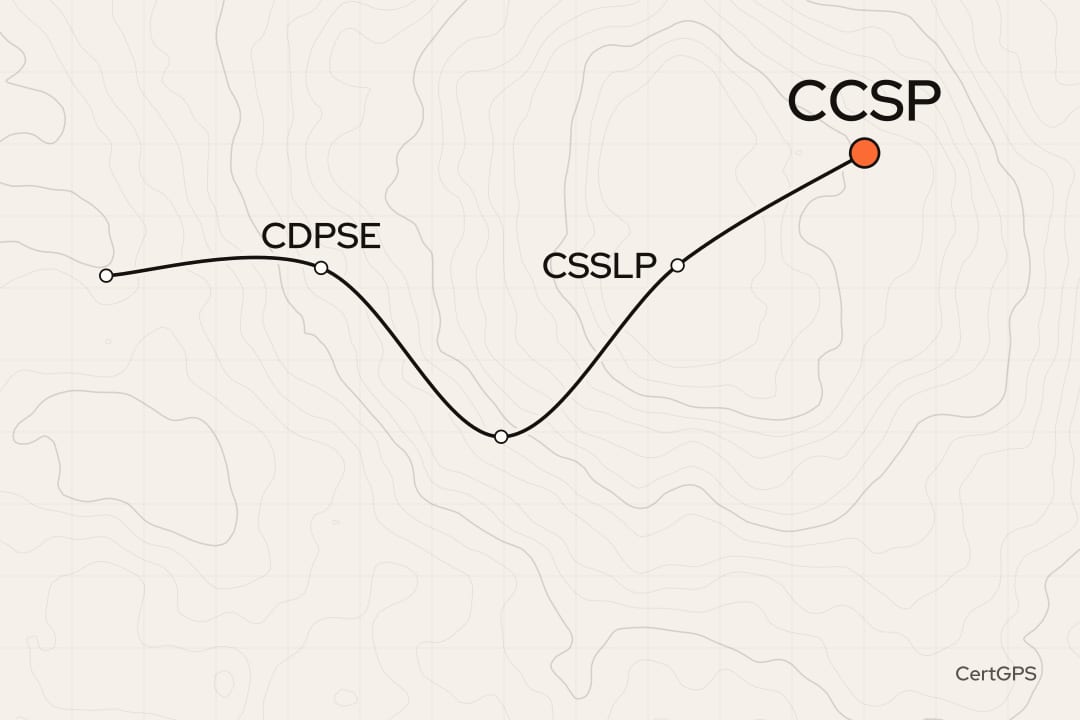
Privacy engineering turns a policy decision about personal data into behavior a system can demonstrate. That can mean reducing what an application collects, enforcing deletion across copies or limiting who can connect records about a person. Choose credentials around those responsibilities. IAPP's CIPT and ISACA's CDPSE address privacy technology, while a secure software credential can support the engineering method needed to implement it.
Start with a data flow you can trace
Choose a small application and map the personal data from collection through storage, use and deletion. Include the places where copies appear: logs, analytics, backups and support tools. Use synthetic data. An attractive diagram is only useful if it matches the application's behavior and identifies the owner of each part of the flow.
Ask why each field exists and what happens if it is removed or made less precise. Then identify the people who decide the purpose, retention and access rules. A privacy engineer needs to translate those decisions into implementation and verification. Legal interpretation should be reviewed with the appropriate privacy or legal owner rather than assumed from a technical title.
NIST's Privacy Framework organizes privacy risk management and provides a useful way to connect technical work with organizational decisions. Treat it as a reference for discussing risk. It does not make the application compliant merely because you map an activity to a framework category.
Learn the engineering behind a privacy promise
A statement that data is deleted needs an operational meaning. Which records are removed? What happens to derived data and copies? How does the system handle a failed deletion job? Write down the intended result before choosing a tool. A demonstrator that reports its limits can show better judgment than an unconditional promise that all copies disappear immediately.
Practise implementing a data minimization change. Replace a precise value with a less identifying value where the application can still serve its purpose, then test the affected behavior. Document the tradeoff and who would need to approve it in a real product. This exercise is advice for building evidence, not a claim that reducing precision always removes privacy risk.
Also learn access control, encryption and secure development. These can support privacy objectives, but a secure storage system can still collect data unnecessarily. Explain both the security protection and the privacy purpose. The distinction will help you discuss a design with developers who already have a security checklist.
Choose CIPT for privacy in technology
IAPP describes the Certified Information Privacy Technologist, or CIPT, as a qualification for building data protection into products and services. It is a relevant starting point for an engineer who needs a structured privacy technology syllabus. Read its body of knowledge before buying training, then compare the topics with the systems you expect to design.
Use preparation to improve an artifact. For example, add a privacy review to a feature proposal and trace each concern to a technical decision or an unresolved question for the product owner. Avoid treating a passed knowledge exam as proof that you can implement every privacy-enhancing technique a vendor advertises.
IAPP's CIPP credentials address privacy law and frameworks for particular jurisdictions, while CIPM addresses program management. Choose one of those when it fills an actual responsibility. A privacy engineer working closely with European requirements may benefit from CIPP/E study, but that does not make the credential a license to provide legal advice.
Put CDPSE at the stage where experience supports it
CDPSE is ISACA's Certified Data Privacy Solutions Engineer. The current guide describes an outline that includes privacy engineering alongside governance, risk and data lifecycle work. It suits a practitioner who can discuss how a privacy requirement becomes part of a system and how that decision is maintained.
The full credential requires qualifying experience. ISACA's rules require professional privacy work across the specified domains; passing the exam alone is not the complete certification. Check the experience application before deciding whether the exam belongs now or after you have taken on additional responsibilities.
Keep a private record of relevant work while gaining that experience. Describe the task, the data flow and your contribution without copying confidential records. Ask a supervisor how the work could be verified later. A list of course completions is not a substitute for the professional experience an issuer requires.
Add software or cloud depth where the role needs it
CSSLP can support a software-focused route when you help with requirements, development and verification. Pair it with a feature that includes retention behavior, access boundaries and an observable failure path. Make the tests readable enough for another engineer to reproduce and challenge.
For a cloud-focused position, learn how data moves between accounts, regions and managed services in the actual platform. CCSP is relevant later for broader cloud security responsibilities, subject to ISC2's experience requirements. Neither credential determines where a specific organization may legally process data; that decision needs the relevant contractual and legal review.
The developer-to-AppSec route can help with secure development practice, and the privacy certification guide compares adjacent qualifications. Avoid collecting all of them before you know whether the role is primarily implementation, assurance or program administration.
Apply with a design review and its test results
Prepare a sample that shows the original data flow, the privacy concern and the revised behavior. Include what remains unresolved. A hiring discussion can then address your reasoning: why you collected less data, how the system enforces the rule and how you would detect a regression after a later release.
Use a staged sequence: establish engineering competence, learn privacy risk and terminology, then select a credential for the work you are taking on. There is no supported universal timetable for becoming a privacy engineer. A useful readiness signal is being able to trace a policy requirement through implementation to evidence, while knowing which decisions require another owner's approval.
Sources (7)
- NIST Privacy Framework: privacy risk management reference, checked October 2026
- IAPP CIPT: privacy technology qualification, checked October 2026
- IAPP CIPP: jurisdiction-focused privacy knowledge, checked October 2026
- IAPP CIPM: privacy program management, checked October 2026
- ISACA CDPSE: privacy engineering credential, checked October 2026
- ISC2 CSSLP: secure software lifecycle, checked October 2026
- ISC2 CCSP: cloud security credential, checked October 2026