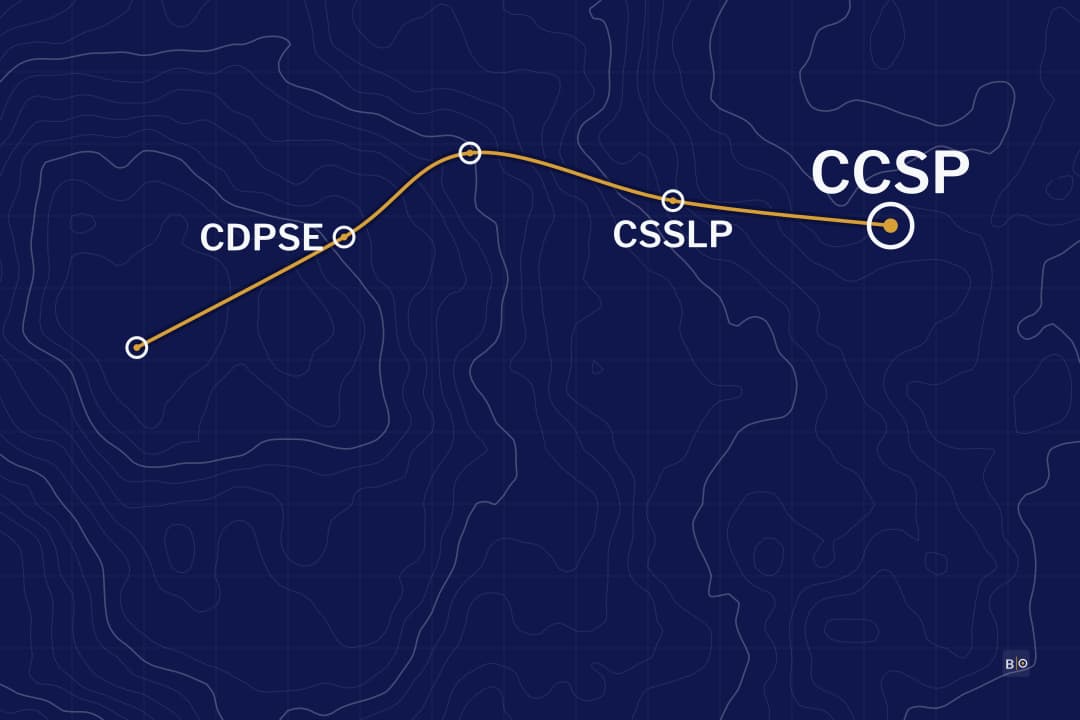
Privacy qualifications are easier to compare once the responsibility is clear. IAPP's CIPP credentials focus on jurisdictional privacy knowledge, CIPM on program management and CIPT on technology; ISACA's CDPSE adds an experience-based privacy engineering route. Start with the decisions your role needs you to support. Collecting all the names is not a substitute for knowing how a particular organization's data is handled.
Identify the privacy question behind the job
A privacy role may interpret requirements with counsel, coordinate an operational process or help developers change a product. Read the work description for the decisions and deliverables. A title such as privacy analyst does not establish which of those activities dominates the role.
Choose a small example to reveal the gap. For a new feature, someone must understand why personal data is collected, how it moves and which rules govern its use. A program owner needs the decision and follow-up process; an engineer needs implementable behavior; a legal or policy specialist needs the relevant jurisdictional context.
NIST's Privacy Framework provides a reference for discussing privacy risk within an organization. Use it to connect the responsibilities, not to turn a framework mapping into a compliance claim. A credential should help you perform one of those responsibilities more effectively and communicate with the people who own the others.
CIPP addresses jurisdictional knowledge
The Certified Information Privacy Professional, or CIPP, has different jurisdiction-focused designations. IAPP describes the relevant laws and frameworks for each. Select the designation that fits the work instead of assuming that passing one version demonstrates knowledge of every jurisdiction where an employer operates.
CIPP/E is relevant to European data protection knowledge, while CIPP/US concerns the United States. Read the current body of knowledge and exam information for the actual designation. Avoid relying on an older course advertisement that collapses all versions into a single generic CIPP exam.
Use study to improve a question you would bring to the appropriate owner. Describe the activity, the parties and the data involved, then identify the interpretation that needs review. A professional knowledge credential does not, by itself, confer a license to practise law or make its holder the final authority on every legal question.
CIPM fits the person running the privacy program
IAPP's Certified Information Privacy Manager, or CIPM, addresses privacy program administration. It fits work that establishes responsibilities, maintains processes and follows implementation across an organization. Compare the syllabus with the actual program responsibilities you will hold rather than choosing it because manager sounds more advanced.
Build a sample workflow for a privacy issue. Record how it is received, who evaluates it, which owner makes the decision and how the result is checked. Use synthetic information. A reviewer should be able to follow the case without relying on an unwritten understanding of who usually handles the problem.
A program credential can support coordination without replacing technical implementation or legal interpretation. When a process requires a product change, identify the engineering owner and the evidence needed to confirm the change. When it requires an interpretation, record who reviewed it and which facts the answer depends on.
CIPT fits privacy decisions in technology
The Certified Information Privacy Technologist, or CIPT, addresses building privacy into products and services. It is relevant when your role includes data flows, design decisions and technical safeguards. Read the current objectives and connect them to a system you can examine or build.
For practice, map where personal data appears in a small application, including copies in logs and supporting services. Propose a minimization or access change and test the result. State the assumptions and remaining risks. Encryption may protect stored data without answering whether collecting that data was necessary.
Pair the study with development or systems knowledge. A knowledge exam cannot establish that you can implement every technique discussed in a course. The privacy engineering route suggests how to build evidence that connects a privacy requirement with observable behavior.
CDPSE requires professional privacy work
CDPSE is ISACA's Certified Data Privacy Solutions Engineer. Its current outline includes engineering alongside governance, risk and data lifecycle responsibilities. The full credential has a professional experience requirement, so check the application rather than assuming that a course and exam immediately provide the qualification.
Use the experience rules to plan work you can actually verify. Record your responsibilities and contribution without copying confidential records into a personal portfolio. Ask how the professional work can be confirmed when you later apply. A certificate of attendance does not substitute for an issuer's required work experience.
CSSLP can complement a software-focused role, while CCSP can support experienced cloud security work. Neither should be described as a complete privacy qualification. Choose the addition because you need its engineering context, and check its own experience and maintenance obligations separately.
Compare credentials without treating them as a license
The EDPB's FAQ says a certificate is not mandatory simply to become a data protection officer. That does not remove the need for expertise or the organizational conditions of the role. A provider-issued DPO certificate should be evaluated for its actual learning and assessment value rather than presented as universal regulatory permission.
Also distinguish a person's qualification from a certification mechanism for processing operations. The award's scope and issuer matter. A professional badge does not certify every data flow operated by the employer or transfer the organization's accountability to the credential holder.
Before purchase, choose the responsibility, check the syllabus and confirm the award you can receive. Build a work sample alongside preparation: a reviewed interpretation question, a program workflow or an implemented design change. The most useful credential is the one whose purpose you can explain through that work, with clear limits on the claims it supports.
Sources
- IAPP CIPP: jurisdiction-specific professional knowledge, checked October 2026
- IAPP CIPM: program administration, checked October 2026
- IAPP CIPT: privacy technology, checked October 2026
- ISACA CDPSE: privacy engineering qualification, checked October 2026
- NIST Privacy Framework: privacy risk reference, checked October 2026
- EDPB FAQ: no mandatory certificate simply to become DPO, checked October 2026
- EDPB accountability tools: processing certification distinction, checked October 2026
- ISC2 CSSLP: secure development credential, checked October 2026
- ISC2 CCSP: cloud security credential, checked October 2026