A private HIPAA certificate is not a guarantee of compliance. HHS says it does not endorse or recognize private organizations' certifications regarding the Security Rule, and those awards do not remove legal obligations. Training can still be useful when it helps you understand the applicable requirements and produce better evidence. Choose the course around your security, privacy or assessment responsibilities and identify the actual issuer.
Start with the rule and the information in scope
HHS distinguishes the HIPAA Security Rule's protection of electronic protected health information from the broader privacy context. Its summary describes administrative, physical and technical safeguards for regulated entities. A general healthcare label does not establish whether a particular organization, service or data flow falls within the rule.
Before selecting training, identify the systems and responsibilities in your role. You might administer access, coordinate an assessment or help a privacy team manage a process. Bring uncertain applicability questions to the organization's appropriate legal or privacy owner instead of treating a course title as the answer.
HHS's current summary also distinguishes the rule in effect from proposed modifications. Check the source status when a provider advertises new requirements. A proposal should be labelled as a proposal until the relevant final action establishes otherwise. Use the current primary material when deciding what a course needs to cover.
Understand what a private certificate establishes
An attendance certificate may show that a person completed a course. An assessed professional award can establish that the person met the issuer's requirements. Neither should be represented as HHS certifying the organization's compliance with the Security Rule.
HHS explains that periodic evaluation remains part of the Security Rule and may be performed internally or with external help. A decision to buy an external evaluation is separate from a claim that a private certificate prevents a later finding of a violation. Read the provider's promised outcome carefully.
Ask for the syllabus, assessment method and exact award name before paying. Check who maintains the content and how updates are handled. Avoid using a provider's marketing phrase as your own professional designation unless it accurately describes the award and the issuer permits that use.
Build a security foundation for the controls you operate
Security+ can help a newcomer organize general security concepts. It is not a healthcare-specific compliance qualification. Pair the syllabus with the systems you will administer, using synthetic records to practise access, logging and recovery without exposing patient information.
For an access example, identify the roles, permissions and approval path. Show what happens when a worker changes responsibilities or leaves. Explain what evidence supports the control and what remains untested. Do not assume that a current account list demonstrates every aspect of how access was managed over time.
A healthcare environment can introduce operational constraints that an ordinary office lab leaves out. Ask the system owner how maintenance and recovery affect service delivery before recommending changes. The security compliance career route can help connect control work with evidence and accountability.
Choose privacy study for privacy responsibilities
IAPP's CIPM addresses privacy program management and CIPT addresses privacy in technology. Either can support relevant professional development, depending on whether your work is coordinating processes or implementing technical behavior. They should not be presented as HHS-issued HIPAA credentials.
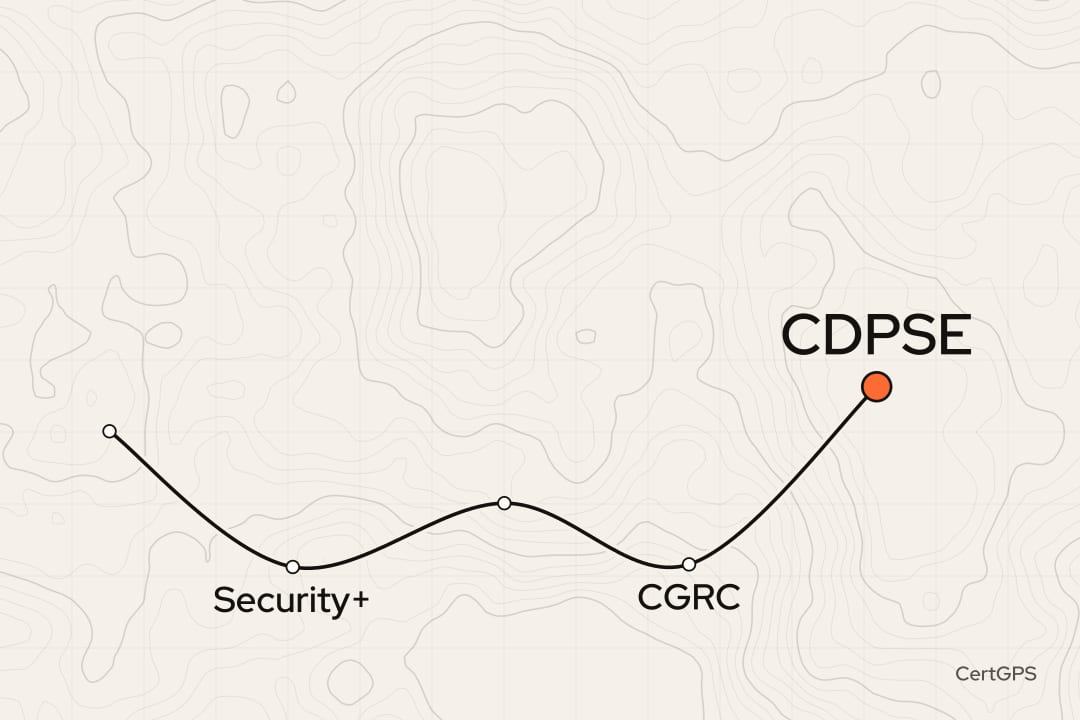
CDPSE is an experience-based privacy engineering qualification from ISACA. It can fit a role that turns privacy requirements into system design and data lifecycle controls. Read its application requirements and current outline before assuming a course and exam immediately provide the full award.
Use privacy study to improve a specific workflow. Map the data involved, the responsible parties and the decisions that require review. A training exercise can show that you understand the process without making an unsupported claim that the exercise satisfies every applicable healthcare privacy obligation.
Use assessment study to improve evidence quality
CGRC concerns governance, risk and control assessment. It may support a practitioner who helps define a system boundary, examine controls and report unresolved issues. Its professional experience requirement and broader framework scope remain separate from HIPAA-specific subject knowledge.
NIST SP 800-66 Revision 2 is a cybersecurity resource guide for implementing the HIPAA Security Rule. Use it with the HHS material to understand the relationship between requirements and security work. It is guidance, not an award that makes an individual or organization certified by NIST.
For practice, select a requirement and identify the control, evidence and test. Write the result so another reviewer can understand the conclusion and its limits. If a control has not been evaluated, record the missing work rather than marking it satisfied because a policy document exists.
Make training part of an operating process
Choose a course that fits the responsibility you will actually carry. An administrator needs practical control knowledge; a program coordinator needs ownership and follow-up; an assessor needs a method for evaluating evidence. No single badge should be described as covering every healthcare security and privacy task.
Keep a record of the content studied, the award received and the practical work completed. Check whether any continuing education claim meets the relevant issuer's requirements. A course being useful at work does not automatically establish eligibility for every certification's renewal credit.
Review the training plan when systems or duties change. If a new service handles data differently, the questions may require more than a refresher quiz. Ask the appropriate owner to review the processing and control implications. The useful outcome is a better-supported decision and a process that can be evaluated, with the private credential described for what it actually demonstrates.
Sources (8)
- HHS private certification FAQ: no HHS endorsement or compliance guarantee, checked October 2026
- HHS Security Rule summary: scope and current versus proposed rule, checked October 2026
- NIST HIPAA resource guide: implementation guidance, checked October 2026
- CompTIA Security+: general foundation, checked October 2026
- IAPP CIPM: privacy program management, checked October 2026
- IAPP CIPT: privacy technology, checked October 2026
- ISACA CDPSE: privacy engineering credential, checked October 2026
- ISC2 CGRC: assessment credential, checked October 2026