A certification purchase can have a clear purpose without a guaranteed financial return. You can calculate the costs you will incur and check whether a role requires the credential; you cannot infer your future raise from a survey of certified professionals. Make the decision around a specific opportunity or skill gap, then compare the exam with other ways to address it.
Define the benefit before calculating a return
Write the result you want in terms you can check. Perhaps an employer requires a particular credential for an application, your manager has agreed that passing meets a development objective or you need a structured way to learn an unfamiliar topic. Avoid beginning with an assumed percentage increase in pay.
If a vacancy names a qualification, confirm the exact requirement and whether alternatives are accepted. If the goal is learning, identify the work you expect to perform afterward. Use the NICE Workforce Framework to name that task. Passing a test and being able to investigate an incident are related outcomes, but one should not be silently substituted for the other.
A credential can remove an explicit application barrier without guaranteeing an interview or offer. Keep that limited benefit visible in the decision. It may still justify the cost, especially if the same preparation improves work you already need to do, but it is not evidence of a predictable employment outcome.
Add the costs beyond the voucher
Use the issuer's current exam price and voucher terms for the version you plan to sit. Add the preparation materials you will actually buy, any required subscription and the costs of attending the exam. Check whether a bundle includes a retake or merely advertises one as an extra option.
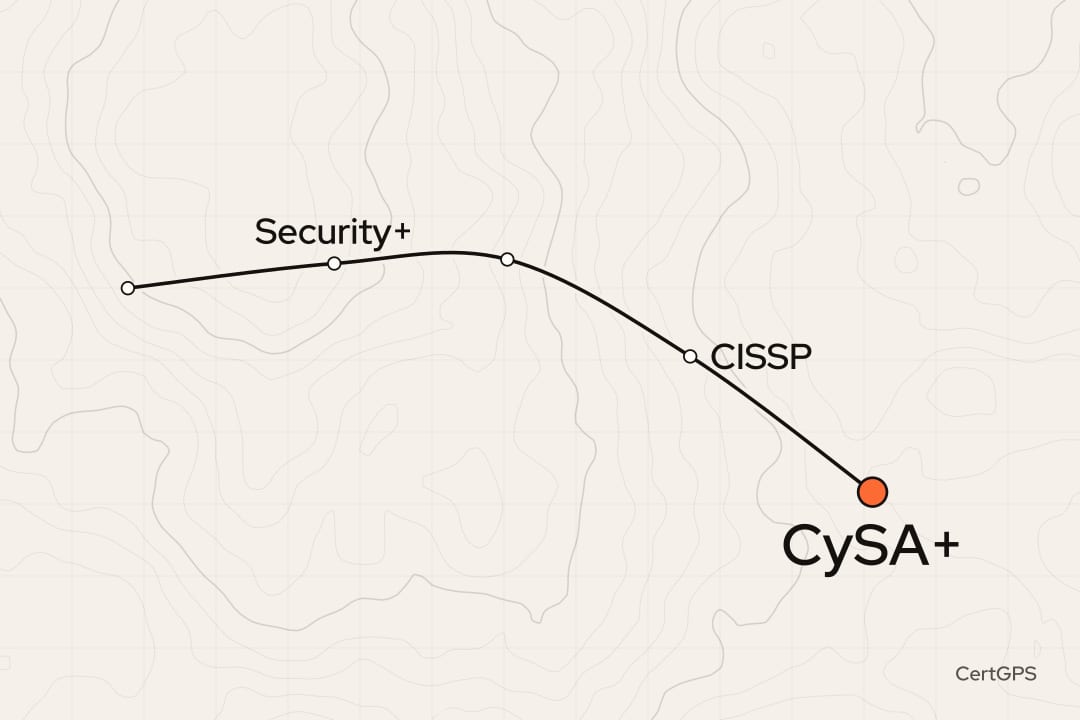
Include the application and maintenance obligations for the full credential. CISSP, for example, requires qualifying professional experience and completion of ISC2's certification process. A candidate who passes early should budget and describe the appropriate route rather than assuming the exam fee immediately buys the full credential.
Keep study time visible, even if you do not assign it a cash value. The alternative may be time spent on a project, work responsibility or another course. Do not invent a standard number of preparation hours for all candidates. Your starting knowledge and the assessment format will affect what preparation you need.
Keep survey earnings separate from causal evidence
The Bureau of Labor Statistics publishes occupational pay information for information security analysts. Its handbook describes an occupation, not the additional earnings caused by passing a named security exam. An occupational median is not a forecast for a beginner, a particular location or a specific credential holder.
Similarly, a salary survey comparing certified and uncertified people can reflect differences in experience, role, geography and employer. Read the publisher's method before using the result. Even a well-described survey does not establish that buying the certification will cause the same earnings difference for you.
Avoid a payback calculation that takes an assumed raise and divides the exam cost by it. The arithmetic may be correct while the premise remains unsupported. If an employer has made a specific documented reimbursement or compensation commitment, use that actual commitment within its conditions instead of substituting a vendor's average.
Compare the exam with a practical alternative
For a newcomer considering Security+, the benefit may be a structured foundation and a credential named by a target employer. The alternative could be guided study without the exam, or supervised operational experience. Check which option addresses the reason you wrote at the start.
For an analyst considering CySA+, compare the objectives with the investigation skills you need. If the gap is using a specific platform, a platform lab may be more direct. If the gap is organizing analysis and response across tools, the broader syllabus may be useful preparation.
Do not treat every alternative as free. A project can require equipment, subscriptions or supervision. Compare the actual costs and expected learning of the options available to you. The point is to make the tradeoff visible, not to manufacture a precise financial score for uncertain outcomes.
Reduce purchase risk using the terms you can verify
Read expiration, retirement and rescheduling rules before paying. A voucher may expire independently of your study plan, and an exam version may retire before you are ready. Choose the exam version first, then the materials and appointment that support it.
Ask an employer about reimbursement before assuming it will cover training. Check whether reimbursement depends on approval, passing, continued employment or a particular provider. Save the relevant policy. A general training budget is not necessarily permission to buy any certification bundle.
Plan a stopping point. If a course shows that the field is a poor fit, you may decide to continue learning without buying the exam. If your target role changes, reassess the credential rather than treating prior study as a reason to make every remaining purchase. Money already spent does not establish the value of the next expense.
Review the outcome without inventing attribution
After the exam or course, record what happened. You can say that you completed a requirement, gained an interview or implemented a new control if those events occurred. Be cautious about claiming that the credential alone caused a promotion or salary change when several factors changed together.
Use that record to improve the next choice. Which material helped at work? Which purchase went unused? Which requirement was real? The multiple-certification strategy can help decide whether another badge adds a distinct capability, while the renewal strategy addresses continuing costs.
Our view is that a defensible certification decision can be quite modest: a bounded cost for a named requirement or a useful learning structure. Buy on that basis when the tradeoff works for you. Leave the projected salary uplift out unless you have evidence that supports the particular claim.
Sources (6)
- BLS information security analysts: occupational data and its scope, checked October 2026
- NICE Framework: task-based learning goals, checked October 2026
- CompTIA Security+: foundation credential, checked October 2026
- CompTIA CySA+: analyst credential, checked October 2026
- ISC2 CISSP experience: full certification eligibility, checked October 2026
- ISC2 member policies: continuing obligations, checked October 2026