The Enterprise Ethereum Alliance's smart contract security specification states that it places no restrictions on who can perform an audit, and credentials for people in this field are just as open. None of the certification bodies in our catalog (ISC2, ISACA, CompTIA, GIAC, OffSec) offers a blockchain security credential, the ones that exist come from small crypto-focused organizations, and public findings give a prospective smart contract auditor evidence an employer can inspect.
Three jobs share the label
"Blockchain security" covers three kinds of work, and each one hires differently.
Smart contract auditing is code review with money attached. Auditors read Solidity, Vyper or Rust, look for flaws in the contract's logic, and write a test that proves each exploit works. The OWASP Smart Contract Top 10 for 2025 shows what they're looking for. Access control flaws rank first, price oracle manipulation second and logic errors third. OWASP based the ranking on 149 incidents in SolidityScan's Web3HackHub for 2024, plus a DeFi attack-vector list and Immunefi's crypto losses report, which together recorded more than $1.42 billion in losses.
Custody and exchange security is closer to classic security engineering. The questions are about keys: where they're generated, who can sign, how cold storage is separated from hot wallets, and what happens when a key holder leaves. Audits here look a lot like any other controls audit, measured against a crypto-specific standard.
Enterprise and permissioned ledgers are mostly ordinary infrastructure and application security. A permissioned ledger needs identity management, network segmentation and patching like any other system. NIST IR 8202, Blockchain Technology Overview, from October 2018, is still a good primer on the consensus models, cryptography and smart contracts underneath.
The standards auditors work to
The EEA EthTrust Security Levels specification, version 3, published in March 2025, defines three levels for Solidity code. [S] is meant to be checkable by an automated tool. [M] adds manual review, where a human auditor decides whether a risky feature is needed. [Q] adds analysis of the business logic, so that the code is shown to do what it claims as well as avoid known vulnerabilities. EthTrust certifies code, not people. The specification says reviewers' claims "are made by themselves" and leaves auditor certification to possible future versions.
For custody, the reference point is the CryptoCurrency Security Standard (CCSS), now at version 9.0, with 41 aspect controls and three levels. CCSS certification "applies to systems, not entities", so an exchange might hold it for one wallet system and not another. An independent CCSS Steering Committee maintains the standard, and the CryptoCurrency Certification Consortium (C4) runs the training and the auditor credential.
The credentials on offer
| Credential | Issuer | What it involves | Who it suits |
|---|---|---|---|
| CCSS Auditor (CCSSA) | C4 | Two live online courses of two days each, then a 100-question, 90-minute exam with a 70% pass mark; renewed annually | Auditors assessing exchanges, custodians and wallet providers |
| CCSS Implementer (CCSSI) | C4 | Training and exam on designing and sequencing CCSS controls | Engineers preparing a system for a CCSS audit |
| Solidity Smart Contract Developer (SSCD+) | Cyfrin Updraft | Proctored exam, with free preparation courses | Developers proving Solidity skills before moving into review |
| Qualified Web3 Signer (QWS) | Cyfrin Updraft | Proctored practical on wallet handling, decoding calldata and multisig setups | Anyone who approves transactions for a protocol treasury |
| Certified Blockchain Security Professional (CBSP) | Blockchain Council | $199 with about 10 hours of self-paced content and an online exam | Newcomers who want a structured overview |
The CCSSA is the most defensible of these. It's tied to a published standard, it requires live training before the exam, and it tests the job it names. It's also narrow: you'd hold it to audit crypto custody systems, and it says little about contract code.
Cyfrin's credentials are newer and more hands-on. QWS is the more useful of the two for security work, because signing is where a protocol's operations staff meet its attackers. A signer who can decode what a transaction actually does before approving it is a control in their own right.
The Blockchain Council's CBSP page lists a price and course hours but not the exam length, pass mark or validity, and it names no third-party accreditation. We'd treat it as a paid course with a certificate attached, and we wouldn't expect an employer to look for it.
What smart contract audit teams hire on
Audit firms and protocols hire on public evidence, because the field produces plenty of it. Competitive audits publish their findings, and bug bounty platforms record who reported what. Code4rena, one of the main contest platforms, lists more than 512 audits, over 16,600 participating researchers and 1,607 unique high-severity findings, and it has announced that it's winding down while it finishes its open contests. Immunefi, a crypto bug bounty platform that says it has paid out more than the rest of the market combined, puts its total at over $140 million for valid findings across more than 650 protocols.
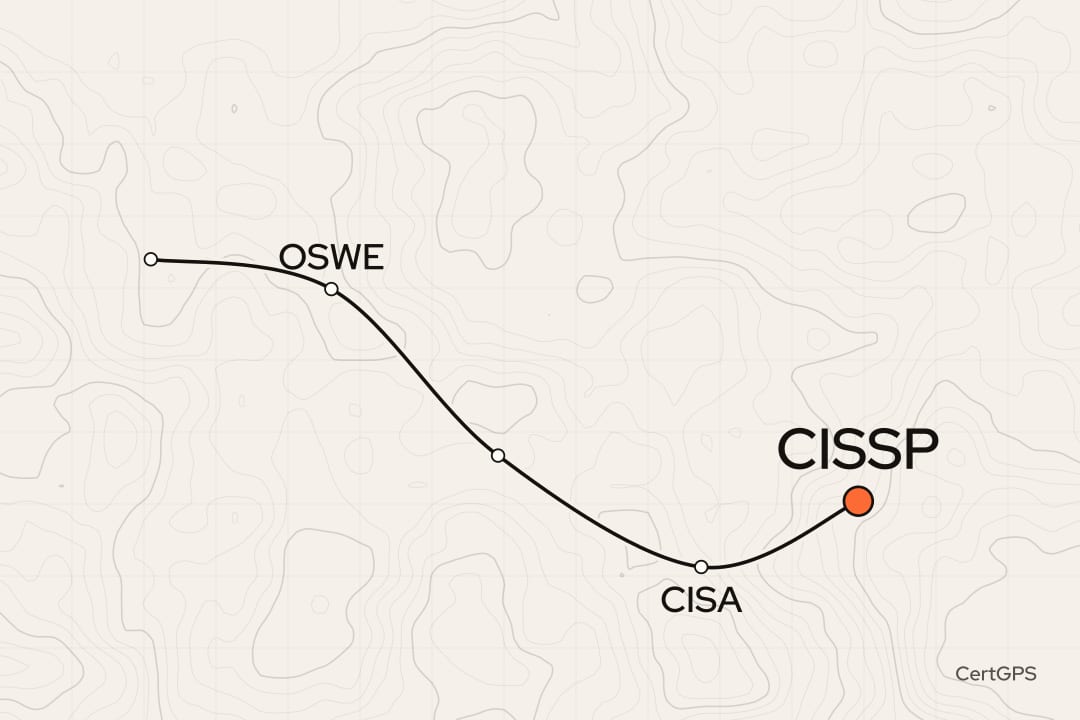
If you want a conventional credential alongside that record, OSWE is the closest in method. It's a 47-hour-45-minute practical in which you find vulnerabilities by reading web application source code and write exploit scripts that run unattended. Code review and exploit development carry over, but contract economics, execution models and languages need separate study. CSSLP suits someone who designs protocols rather than reviewing them.
Custody, exchanges and enterprise ledgers
The custody side hires more like a bank. Security engineers at exchanges and custodians tend to hold the general credentials: CISSP for program and architecture roles, CISA for the people who run or face audits, and a cloud credential where the platform runs on one. CCSSA fits on top when an employer is pursuing CCSS certification or offering CCSS audits to clients. Our fintech security path covers the regulatory side that exchanges share with payments companies, and our blockchain security career guide looks at the roles in more detail.
Our view
If you want to audit smart contracts, skip the paid blockchain certificates. Read the OWASP Smart Contract Top 10 and the EthTrust specification, enter contests or submit bounty reports, and let the results stand as your credential. If you want to secure custody or an exchange, earn the credential for the underlying job first, CISSP or CISA, and add CCSSA if your employer works to CCSS. If exchanges start requiring CCSS for their wallet systems, CCSSA would become the one blockchain credential with real hiring weight.
Sources (14)
- EEA EthTrust Security Levels Specification v3: March 2025 version, the three levels, code-only certification, no restriction on who audits, checked October 2026
- OWASP Smart Contract Top 10: 2025 ranking, 149 incidents and $1.42 billion in losses behind it, checked October 2026
- NIST IR 8202: Blockchain Technology Overview: October 2018 publication and scope, checked October 2026
- C4: CryptoCurrency Security Standard: version 9.0, 41 aspect controls, three levels, system-level certification, Steering Committee, checked October 2026
- C4: CCSSA certification: required courses, 100 questions, 90 minutes, 70% pass mark, annual renewal, CCSSI and other C4 certifications, checked October 2026
- Cyfrin: Certifications: SSCD+ and QWS scope and proctoring, checked October 2026
- Cyfrin Updraft: What is a professional certification: proctored, exam-based format, checked October 2026
- Blockchain Council: Certified Blockchain Security Professional: $199 price, 10 hours, online exam, checked October 2026
- Code4rena: audit, researcher and finding counts, wind-down notice, checked October 2026
- Immunefi: $140M+ paid across 650+ protocols and the market-share claim, checked October 2026
- OffSec WEB-300: OSWE scope, checked October 2026
- ISC2: CSSLP: audience and experience requirement, checked October 2026
- ISC2: CISSP: five-year experience requirement, checked October 2026
- ISACA: CISA certification: audit credential scope, checked October 2026