5G security assurance is built for equipment, not people. Under GSMA's NESAS scheme, vendors have their development processes audited and their network products tested in ISO/IEC 17025-accredited labs against 3GPP's security specifications, and NESAS does not issue personal credentials to the engineers who run the networks. The only 5G-specific security exam for individuals we could confirm comes from a vendor: Nokia Bell Labs' 5G Secured Networks, at €125 through Pearson VUE.
Who writes 5G security
The security of a 5G network is defined in 3GPP's specifications, written by its SA3 security working group. The core document is TS 33.501, Security architecture and procedures for 5G System. It was first created for Release 15 in 2017 and is still under change control: the 3GPP portal lists a Release 20 version uploaded in September 2026. A 2018 overview by SA3 members lists what changed from 4G: 5G-AKA and EAP-AKA' authentication methods, protection of the subscriber's permanent identifier using a home network public key, security for the new service-based architecture of the core, a revised key hierarchy, and home-network confirmation that a roaming device really was authenticated.
3GPP also writes Security Assurance Specifications (SCAS), which are test catalogues for network products. TS 33.117 is the generic one, and there are function-specific SCAS documents for individual network elements. These feed NESAS, the Network Equipment Security Assurance Scheme run by GSMA, the mobile operators' association. In the version 2.1 overview, GSMA appoints audit organisations that assess vendors' development and product lifecycle processes, and NESAS security test laboratories, accredited under ISO/IEC 17025, evaluate products against the SCAS tests. The same document says plainly that NESAS involves "no certification of Equipment Vendors or network equipment by an officially recognised authority", and it doesn't certify individuals at all.
For someone building a career, this matters because the evidence an operator collects about its network is vendor audit reports and lab evaluations. The security engineer's job is reading those, deciding what they don't cover, and testing the rest in the operator's own configuration.
The documents worth reading
| Document | Publisher | What it gives you |
|---|---|---|
| TS 33.501 | 3GPP SA3 | The 5G security architecture: authentication, keys, signalling protection, identifier concealment |
| TS 33.117 and the SCAS series | 3GPP SA3 | Security test requirements for network products |
| NESAS overview (FS.13) | GSMA | How vendor audits and product evaluations work |
| 5G Network Slicing: Security Considerations | CISA and NSA | Threats to network slicing and how to harden it, July 2023 |
| Security Guidance for 5G Cloud Infrastructures, Parts I to IV | CISA and NSA | Lateral movement, isolation, data protection and integrity in the cloud-native core |
| SP 1800-33, 5G Cybersecurity | NIST NCCoE | A practice guide, still in draft since March 2025 |
| Telecommunications Security Code of Practice | UK government | How UK providers meet the Telecommunications (Security) Act 2021; version 1.1 issued July 2026 |
The CISA and NSA documents came out of the Enduring Security Framework, a government and industry group, and they're the most practical of the set. The cloud infrastructure series is the one to read if you come from IT security. The UK code matters if you work for a UK operator, because it sets out what the regulations expect of large and medium providers.
The Nokia exam
Nokia's 5G Secured Networks certification sits in the professional level of the Nokia Bell Labs 5G Certification Program. To earn it you pass exam BL0-280, a written exam booked through Pearson VUE for €125. Nokia recommends a course, BL00280-K-2103, but says candidates don't have to take it. The course runs through 5G security features, 5G system security, risk management applied to case studies, and security orchestration, automation and response.
It's the closest thing to a 5G security credential we found, and it's cheap enough to justify if you work with Nokia equipment or for an operator that does. The course is still written by one vendor, so treat it as a structured introduction to 5G security concepts and check anything vendor-specific against the 3GPP documents.
Where operators' security staff come from
Two backgrounds lead into this work.
Network engineers who already run radio access or core networks know the architecture and the signalling, and need security method on top. For them, Cisco's CCNP Security fits if the transport network is Cisco, and Security+ covers the general ground.
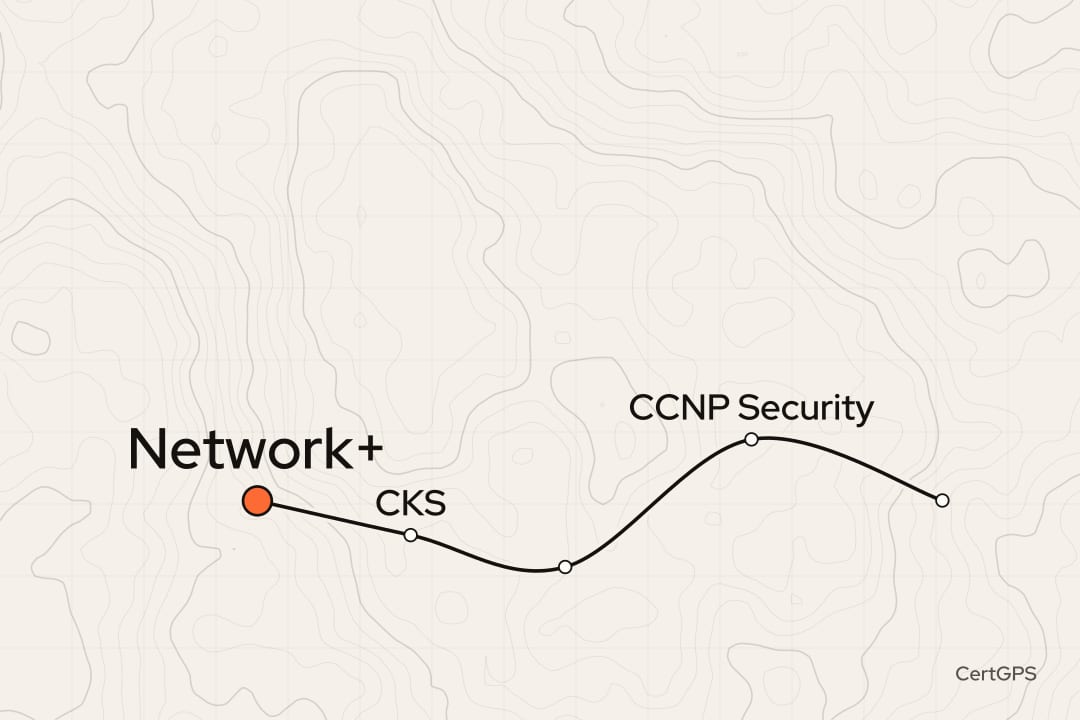
Security engineers from IT or cloud backgrounds need to learn the network. The 5G core is built as a service-based architecture of software network functions, and when it runs on cloud infrastructure the threats are familiar ones. The CISA and NSA cloud series opens with preventing lateral movement and isolating network resources, which reads like ordinary cloud security applied to a phone network. CKS, the Linux Foundation's performance-based Kubernetes security exam, maps well to that part of the job. Network+ is a reasonable start for someone who has never worked on networks.
Our telecom security career guide covers the wider operator job market, and our 5G security careers article looks at the roles in more detail.
A route through the credentials
Start with the networking you don't yet have. For an IT security person that means Network+ or equivalent experience with routing, mobile architecture and the 5G service-based design. For a network engineer it means Security+.
Next, pick the platform credential that matches your operator. If the core runs on Kubernetes, CKS. If the transport and security appliances are Cisco, CCNP Security.
Then read TS 33.501 and the CISA and NSA slicing and cloud guidance with your own network in mind, and the Nokia exam becomes a short step if your employer uses that vendor. You'll know you're ready for 5G security work when you can explain how a subscriber authenticates to the core, where the keys come from, and which network functions an attacker inside the cloud platform could reach.
Sources (11)
- 3GPP: TS 33.501 specification details: title, SA3 responsibility, Release 15 creation in 2017, Release 20 version of September 2026, checked October 2026
- 3GPP: 3GPP 5G Security: August 2018 overview of 5G authentication, identifier protection, SBA security and key hierarchy, checked October 2026
- GSMA FS.13: NESAS Overview, version 2.1 (PDF): audit organisations, ISO/IEC 17025 test labs, SCAS evaluation, TS 33.117, scope exclusions, checked October 2026
- CISA: 5G security: Enduring Security Framework, network slicing guidance of July 2023, 5G cloud infrastructure guidance parts I to IV, checked October 2026
- NIST SP 1800-33: 5G Cybersecurity (draft): March 18, 2025 draft status, checked October 2026
- UK government: Telecommunications Security Code of Practice 2026: version 1.1 of July 14, 2026, legal basis, scope, checked October 2026
- Nokia: Bell Labs 5G Professional Certification, 5G Secured Networks: exam BL0-280, €125, Pearson VUE, optional course, course units, checked October 2026
- Cisco: CCNP Security certification: exam structure, checked October 2026
- Linux Foundation: CKS: performance-based format, checked October 2026
- CompTIA Network+: scope, checked October 2026
- CompTIA Security+ V7: scope, checked October 2026