Threat intelligence work starts with a question someone needs answered. A list of domains, a report about an attacker or a dashboard of alerts becomes useful when it changes a decision about protection, detection or response. Build your route around asking that question, evaluating the evidence and writing an assessment a reader can challenge. Technical certifications help with parts of the work, but no exam supplies the whole analytical habit.
Choose a consumer before choosing a feed
Start with a real or clearly hypothetical consumer. A vulnerability team may need to decide which exposed service to address first. A SOC may need to know which behavior to test in its detections. A product team may be assessing the threats relevant to a feature. Each question calls for different evidence and a different deliverable.
NIST's NICE Threat Analysis role is a useful reference for the collection and analytical tasks. Read it beside a job description and ask who uses the team's output. A role devoted to technical detection support differs from one that briefs business leaders, even when both carry the same analyst title.
For a practice project, write the question before collecting material. Define what would count as an answer and when it would be needed. If the question cannot change any plausible decision, tighten it. This keeps the portfolio from becoming a collection of summaries that demonstrate reading effort but little judgment.
Evaluate the source and the claim separately
Keep a record of where each observation came from and what it directly supports. A report can contain reliable technical evidence and a less certain conclusion about who was responsible. Repeating the conclusion without that distinction makes your assessment sound more confident than the material allows.
Use multiple sources where they offer independent evidence. Several articles repeating the same vendor report do not create several independent confirmations. Trace the claim back to the original publication and note what the publisher actually observed. Distinguish first-hand incident evidence from an analyst's inference about broader intent.
MITRE's ATT&CK resources can help organize adversary behavior, but a technique mapping does not establish attribution on its own. Use the framework to describe what happened or what you propose to test. A useful early portfolio item is an assessment that states its assumptions, competing explanations and the new evidence that would change the conclusion.
Learn enough technical detail to avoid weak assessments
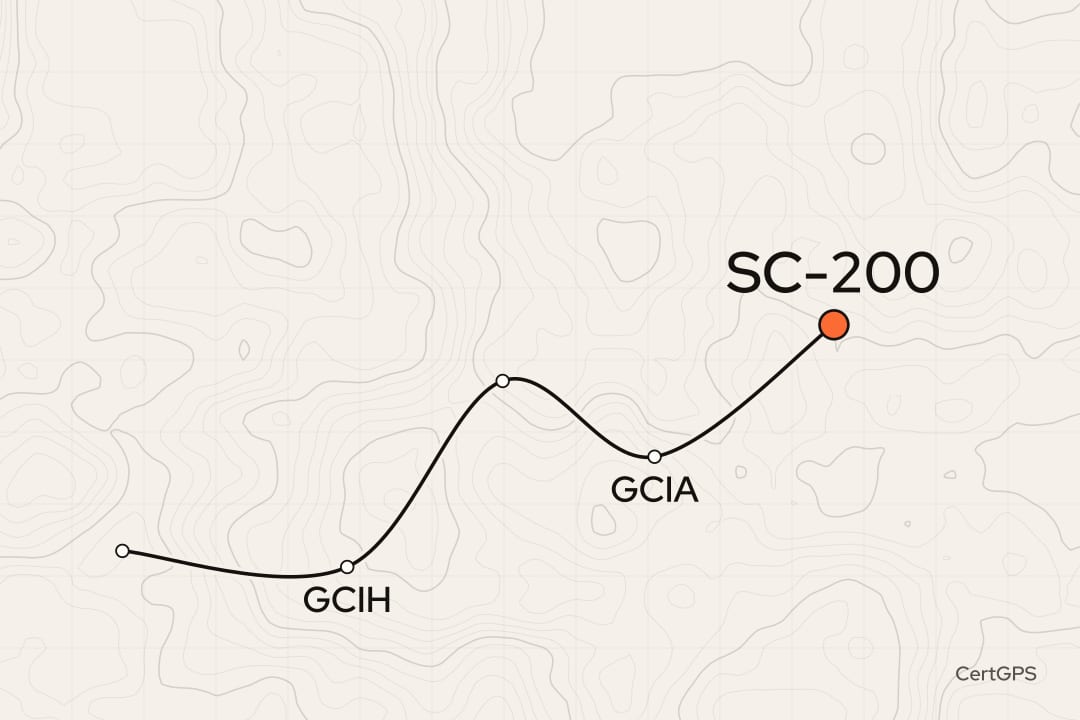
If your consumer is a SOC, you need to understand the telemetry behind a detection recommendation. GCIA is relevant when network protocols and traffic analysis are the recurring gap. It is a network-analysis credential, not a complete threat intelligence qualification, so choose it for the evidence work it teaches.
GCIH can strengthen understanding of attack techniques and incident handling. It fits an analyst whose summaries describe adversary behavior they have never examined in a lab. Pair the study with a safe exercise that generates the evidence a defender would actually see.
For a Microsoft-focused SOC, SC-200 can help connect an assessment to Sentinel and Defender investigations. Microsoft's English exam updates on October 21, 2026. Pick the current study guide and practise the queries relevant to your consumer's questions. Our SOC career ladder covers the operational role if you decide investigations interest you more than intelligence production.
Consider GCTI for the analytical specialization
GIAC offers the Cyber Threat Intelligence certification, GCTI, outside the CertGPS catalog. Its published objectives address intelligence analysis and its application to cybersecurity work. Read the issuer's objectives before buying a course so you can distinguish the analytical material from technical subjects you already know.
The credential is a reasonable choice when the gap is producing and applying intelligence, rather than learning the underlying operating systems or networks. An employer-funded course can provide a structured way to practise that work. A self-funded learner should compare the objectives with MITRE's publicly available ATT&CK training and the analytical projects they can review with a mentor.
Compare GCTI with the technical credentials by the syllabus and the work sample each should improve. Its specialist focus can be useful when an analyst already understands the systems producing the evidence. A certificate without an assessment you can explain gives an interviewer less to examine than the course title suggests.
Turn an assessment into a testable recommendation
Take the assessment to its intended consumer. If you recommend a detection, identify the required data and a safe way to test the logic. If you recommend vulnerability prioritization, explain the connection between the external evidence, the organization's affected assets and the action being proposed.
CISA's Known Exploited Vulnerabilities catalog is a useful input to prioritization because it records vulnerabilities with evidence of exploitation. It does not tell you that a particular organization was attacked. Check whether the vulnerable product is present and exposed before presenting a catalog entry as an incident finding.
Ask the consumer what they did with the assessment. An actionable result may be changing a patch priority, running a test or deciding the evidence does not justify a change. Record that outcome and the reason. You are ready for broader responsibility when your work can survive technical review and still answer the original decision question.
Progress toward ownership of the intelligence service
A senior analyst helps set the questions, collection priorities and review standards for other analysts. Practise by reviewing a colleague's assessment for evidence, uncertainty and usefulness. Explain what information is missing and why it affects the decision, rather than simply making the prose more confident.
As the scope grows, manage the cost of collection and the risk of stale material. A source that was useful during one incident may not answer the next question. Give each recurring product an owner and a reason to continue. A briefing produced on schedule has little value if its consumers stopped using it months ago.
We would judge progression by the decisions your assessments support and the quality of their evidence. Keep a portfolio of authorized, shareable work that shows both. The security researcher route fits people drawn to discovering new technical facts; the incident response route fits those who want to act on the evidence inside a live case.
Sources (8)
- NICE Threat Analysis: analytical tasks, checked October 2026
- MITRE ATT&CK: behavior knowledge base, checked October 2026
- MITRE ATT&CK CTI training: public intelligence training, checked October 2026
- GIAC GCTI: real specialist credential and objectives, checked October 2026
- GIAC GCIA: network-analysis scope, checked October 2026
- GIAC GCIH: attack and incident scope, checked October 2026
- Microsoft SC-200 study guide: current objectives and update date, checked October 2026
- CISA KEV catalog: exploitation evidence and prioritization use, checked October 2026