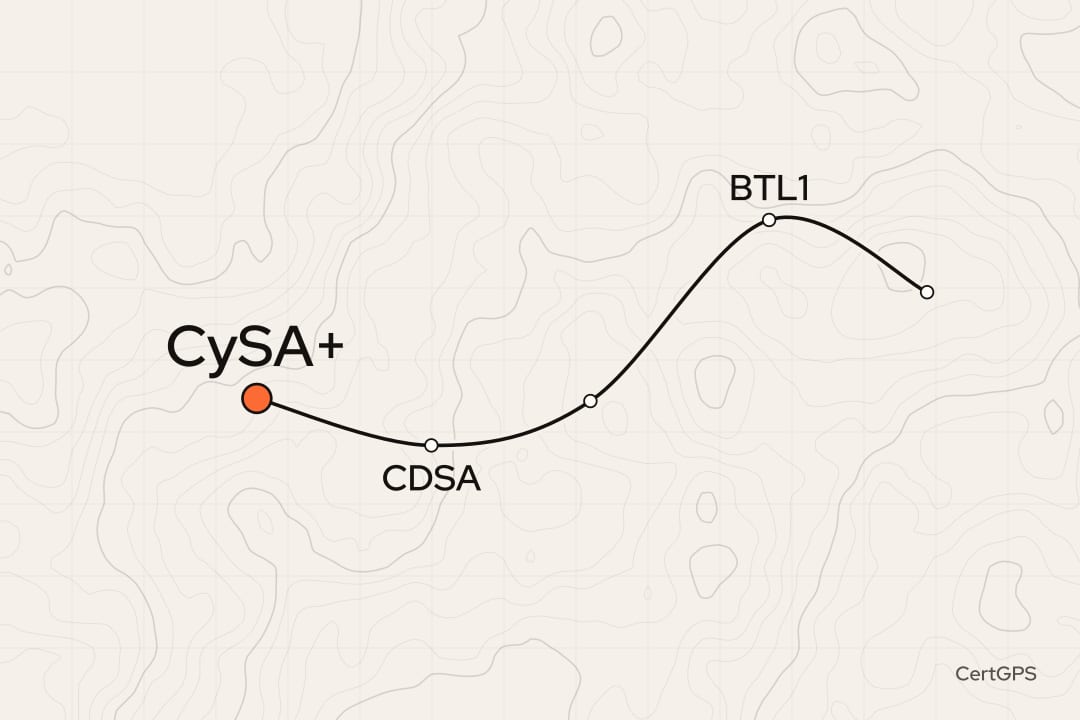
Security operations includes alert review, investigation, detection work and coordination with system owners. A team can divide those duties in several ways, so there is no single certification that makes someone ready for every SOC role. Choose a route by the work you will perform and the evidence the employer expects you to explain.
Map the job before the syllabus
Ask which data sources and systems the team monitors and what an analyst may do after identifying a concern. Some roles emphasize triage and escalation; others include containment, engineering or deeper network investigation. The same title can describe different responsibilities across employers.
NIST's incident-response guidance places detection and response within organizational risk management. It helps explain why an analyst's findings need an owner and an action path. A convincing technical account is incomplete if nobody can decide what to do with it.
Ask about supervision and handoffs, including which decisions require review and how the team documents its reasoning for later investigation. A junior analyst should know who reviews an uncertain conclusion, how urgent cases are escalated and what information the next person needs. A credential can organize study, but it does not define those employer-specific working arrangements.
Practical foundations: BTL1 and CDSA
Centri's BTL1 program covers practical defensive learning across several operational areas. It can suit someone who needs a structured introduction to investigating evidence rather than studying only definitions. Inspect the syllabus to identify which parts will be new and which repeat skills you already use.
HTB CDSA provides another practical defensive route, with its own required learning and reporting process. The issuer's certification guidance explains the current process. Its assessment should be compared on its own rules rather than assumed equivalent to another vendor's practical exam.
Our BTL1 guide and CDSA guide describe the catalog routes. Neither should be presented as a guaranteed placement program. The relevant result is a demonstrated ability to investigate and communicate within the assessment's scope, followed by the employer's own evaluation.
Broader analyst study: CySA+
CompTIA's CySA+ program provides a broader analyst assessment with published objectives. Use the current outline and version when comparing it with the work you want. A general analyst syllabus can help connect topics without teaching every interface in an employer's deployed tools.
If you are already practicing investigations, use the objectives to identify gaps rather than assume the credential replaces that practice. Explain how the concepts connect to a log, an identity or a system you understand. A definition becomes useful when it changes how you investigate a real question.
Our CySA+ guide covers version-specific information. Confirm the exam you intend to sit before buying a preparation package, especially where older and newer assessments coexist. A course's familiar title is not enough to establish that its content matches your attempt.
Platform operations: SC-200
Microsoft's Security Operations Analyst certification addresses work in its security operations environment. It is relevant when the employer uses those services and expects you to investigate through them. Read the current assessment outline instead of assuming an older tutorial still matches the portal and workflows.
A product assessment should be paired with an understanding of the evidence underneath the interface. Determine which events produced an alert, how the platform groups them and what remains outside its visibility. A dashboard can organize the case without proving that the resulting narrative is complete.
Our SC-200 guide provides the catalog detail. Choose it for a platform-related gap, not because every analyst needs the same vendor credential. An employer using another environment may assess similar reasoning through different tools and terminology.
Network specialization: GCIA
GIAC's GCIA program focuses on intrusion analysis and network evidence. It becomes relevant when your work requires understanding traffic and detection behavior more deeply. That is a different purpose from learning a broad junior workflow or a particular cloud security portal.
Network evidence needs context. Ask what was captured, where it was observed and which activity the data cannot reveal. Encryption, missing capture points and incomplete retention can limit the available account. A useful analyst states those limits rather than assumes every connection can be reconstructed.
Our GCIA guide describes the assessment. Consider it when the specialization addresses your role, and build the networking foundation its objectives assume. A broad security credential is not a substitute for understanding the traffic you are asked to interpret.
Practice the complete analyst handoff
Create a bounded lab investigation with a known signal. Record what you checked, what you concluded and the evidence supporting the conclusion. Distinguish a confirmed fact from a plausible explanation and identify the question that would most improve confidence.
Write a handoff containing the affected system, relevant times, proposed action and unresolved issue. Explain which owner should review the recommendation. Label the lab clearly and avoid presenting simulated work as production experience or claiming that a successful exercise establishes readiness for every incident.
Before choosing training, compare the full commitment: assessment, access, required path and maintenance. Ask whether the employer supports the expense and study time. A lower initial price may cover a different product, and a wider syllabus may repeat knowledge instead of fixing the current gap.
Our view is to start with a foundation appropriate to your system knowledge, then specialize in the evidence or platform your role needs. You do not need every credential in this guide. You need a defensible account of what you can investigate, how you communicate it and where you seek review.
Sources (7)
- NIST response guidance: organizational response context, checked October 2026
- Centri BTL1: practical defensive scope, checked October 2026
- HTB CDSA: defensive assessment, checked October 2026
- HTB process: current certification process, checked October 2026
- CompTIA CySA+: analyst outline, checked October 2026
- Microsoft analyst credential: platform-specific scope, checked October 2026
- GIAC GCIA: network analysis scope, checked October 2026