The best material on space cybersecurity is free: NIST's satellite reports, the security standards of the Consultative Committee for Space Data Systems (CCSDS) and The Aerospace Corporation's SPARTA attack matrix. Certification is thinner, because no standards body or major exam vendor issues one for space. Employers hire on general security certifications, a clearance for defense work, and evidence that you've worked with radio and embedded systems.
Three segments, three kinds of job
A satellite mission has a ground segment, a link segment and a space segment, and the security work differs in each.
The ground segment is mission control, ground stations and the networks between them. Most of it is ordinary IT and operational technology, with the difference that a compromise can send commands to a spacecraft. NIST wrote a whole report on this part. The link segment covers the radio links for telemetry, tracking and command, where the questions are encryption, authentication of commands, key management and resistance to jamming and spoofing. The space segment is the spacecraft itself: flight software, onboard buses and payloads, usually running on embedded processors that can't be patched as freely as a server.
Ground-segment roles look like security engineering anywhere else, which makes them the easier way in. Link and spacecraft roles reward firmware analysis, exploit development and radio skills.
The documents the work runs on
US policy starts with Space Policy Directive-5, issued on September 4, 2020. It sets principles rather than controls: risk-based, cybersecurity-informed engineering; authentication or encryption on command and control links; physical protection of command, control and telemetry receivers; protection against jamming and spoofing; ground systems hardened with basic hygiene such as patching and segregation; and supply chain risk management.
NIST turns that into practice in two reports. NIST IR 8270, Introduction to Cybersecurity for Commercial Satellite Operations (July 2023), introduces risk management for operators. NIST IR 8401, Satellite Ground Segment (December 2022), applies the NIST Cybersecurity Framework to satellite command and control. If you read one document before an interview, read IR 8401.
The international engineering standards come from CCSDS, whose eleven member agencies include NASA, ESA, JAXA and the Chinese and Russian space agencies. Its Green Book 350.1-G-3, Security Threats against Space Missions (February 2022), characterizes threats by mission type and how likely they are. Its Space Data Link Security Protocol, CCSDS 355.0-B-2 (July 2022), defines authentication and encryption for the frames that carry telemetry and commands, and a 2024 Green Book, 350.11-G-1, explains the extended procedures for key and security association management.
For attack techniques, The Aerospace Corporation publishes SPARTA (Space Attack Research and Tactic Analysis), a matrix of tactics, techniques and countermeasures covering spacecraft and ground systems. Version 4.0.1 went live on August 24, 2026. Aerospace also maps SPARTA to NIST SP 800-53 controls, which makes it the bridge between a threat model and a control baseline.
What's sold as space security training
Several programs use the word "certificate" for space cybersecurity, and they differ a lot in what's behind the word. Indiana University's Kelley School of Business runs a Space Cybersecurity Digital Badge, delivered online over ten weeks or in a five-week intensive format. To earn the badge you attend 80% of sessions and pass a quiz or a cyberattack postmortem with 80% or better, according to Kelley's program page, and the badge counts toward Kelley's Cybersecurity Management Graduate Certificate. That's a university course with a defined assessment and academic credit attached.
Commercial training companies also sell courses with "Certified" in the name. These are course completions issued by the company that taught the course, without the independent accreditation behind exams such as Security+ or CISSP. Some are good training, but the name carries no outside recognition, so you'll have to explain it on a CV. Space ISAC, the industry's information-sharing body, offers free training courses to member organizations, so check whether your employer is a member before paying for anything.
What employers ask for instead
If the employer is a defense contractor or a military customer, the requirements change. US Department of Defense cyber roles are governed by DoDM 8140.03, and both ISC2 and CompTIA state that their certifications are approved or mapped under it: CISSP for senior roles, Security+ for entry roles. Defense space jobs may also need a security clearance; our government clearance guide covers how certifications and clearances interact.
On the commercial side, the ground segment hires network, cloud and operational technology security people. Where ground stations look like industrial control systems, GIAC's Global Industrial Cyber Security Professional (GICSP), an 82-question, three-hour exam with a 71% pass mark, is a reasonable fit. Our ICS and SCADA guide covers that family.
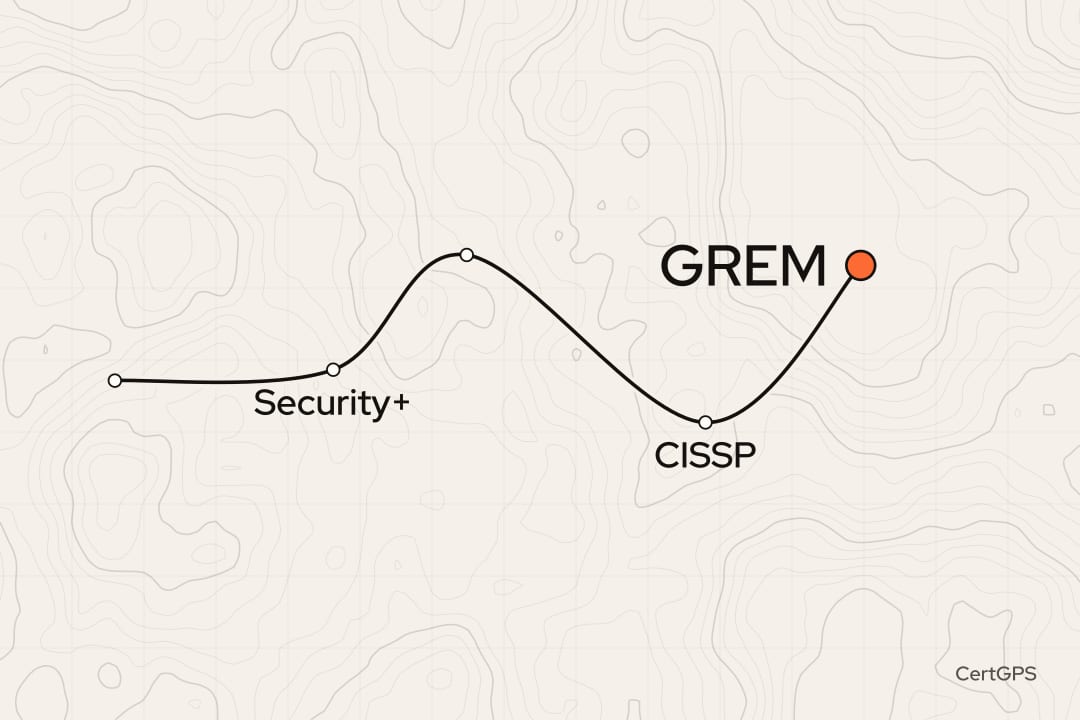
For spacecraft and link work, the useful certifications prove you can take apart compiled code. GREM covers reverse engineering of Windows malware, and OSED covers finding and exploiting memory corruption bugs. Neither is about flight software, but both prove the method. Then show it on space hardware or software. Hack-A-Sat, a space security capture-the-flag competition, ran its fourth edition against Moonlighter, a satellite in orbit, and competing in an event like it is the most direct evidence you can show.
A route in
- Start with a general certification that matches your target employer: Security+ for a defense contractor, a cloud or network certification for a commercial operator's ground segment.
- Read SPD-5, NIST IR 8401 and the CCSDS threats Green Book, then work through SPARTA for one mission type. You should be able to explain how a command link is authenticated and what happens when it isn't.
- Build a small software-defined radio lab and decode public satellite telemetry. Write up what you learn.
- Specialize by segment: ICS knowledge and GICSP for ground stations, reverse engineering and exploit development for spacecraft and links, CISSP once you're leading programs.
Our view
Spend money on a recognized general certification and time on the free space documents. A course badge from a university is a reasonable addition if your employer pays. A paid "certified space security" title from a training company adds little that SPARTA, IR 8401 and a radio lab won't teach you, and it doesn't carry recognition with defense employers, who check DoDM 8140.03 approvals.
Sources (14)
- Space Policy Directive-5: September 4, 2020 date and cybersecurity principles, checked October 2026
- NIST IR 8270: Introduction to Cybersecurity for Commercial Satellite Operations, July 2023, checked October 2026
- NIST IR 8401: Satellite Ground Segment, December 2022, scope, checked October 2026
- CCSDS 350.1-G-3 Security Threats against Space Missions (PDF): February 2022 issue, scope, the eleven member agencies, checked October 2026
- CCSDS 350.11-G-1 Space Data Link Security Protocol Extended Procedures (PDF): July 2024 issue, reference to CCSDS 355.0-B-2 of July 2022 and its authentication and encryption services, checked October 2026
- The Aerospace Corporation: SPARTA: purpose, scope, v4.0.1 release date, NIST SP 800-53 mapping, checked October 2026
- Kelley School of Business: Space Cybersecurity Digital Badge: format, length, assessment and credit toward the graduate certificate, checked October 2026
- Space ISAC: mission, membership types and member training, checked October 2026
- ISC2: CISSP: DoDM 8140.03 approval, checked October 2026
- CompTIA Security+ V7: DoD 8140 work role mapping, checked October 2026
- GIAC: GICSP: scope, 82 questions, 3 hours, 71% passing score, checked October 2026
- GIAC: GREM: scope, checked October 2026
- OffSec EXP-301: OSED scope, checked October 2026
- Hack-A-Sat: competition description and Hack-A-Sat 4 on the Moonlighter satellite, checked October 2026