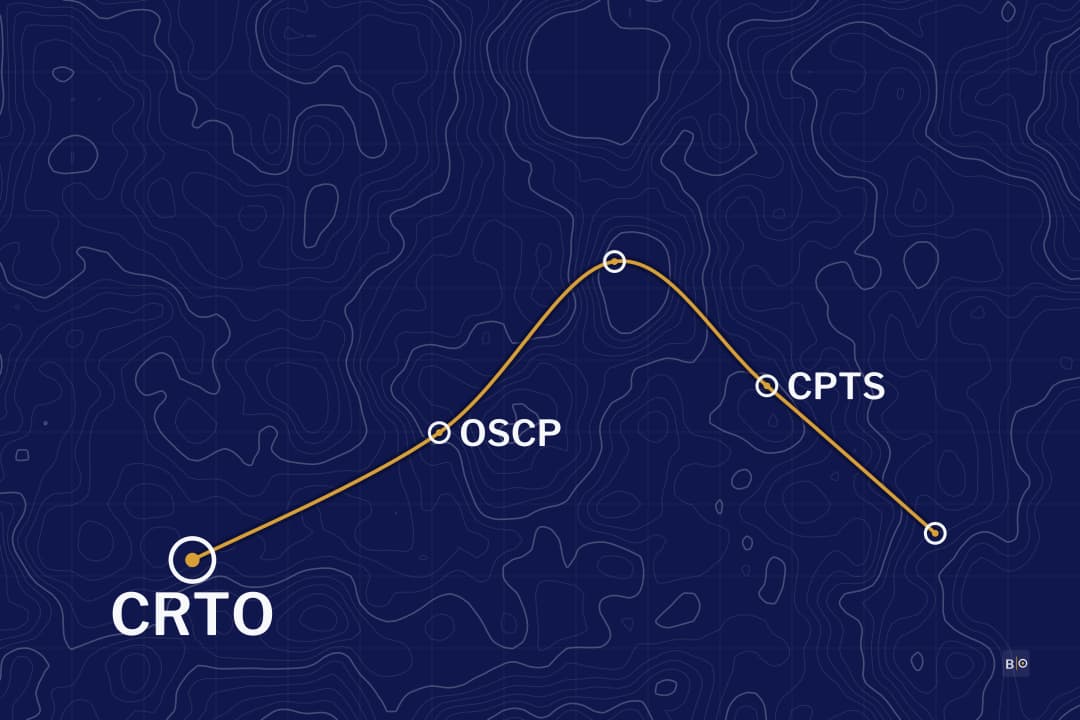
A red team exercise tests an agreed objective against an organization's defenses. The operator needs testing skill, but also a plan that stays within authorization and leaves the organization able to learn from the result. Build a penetration-testing foundation first, then practise objective-led exercises with defenders and reviewers. A more difficult exploit exam is useful only if it fills a gap in that work.
Establish the assessment foundation
Before planning an adversary exercise, be able to enumerate a test environment, understand the trust relationships and write a reproducible report. The NICE Vulnerability Analysis role and NIST SP 800-115 provide useful references for assessment work. Both help keep planning and evidence attached to the technical activity.
CPTS and OSCP are practical options for that foundation. Hack The Box ties CPTS to a mandatory learning path and a report-based engagement. OffSec's OSCP exam has strict evidence and report requirements. Choose the course structure and credential that fit your background and target employers rather than taking both as an automatic admission requirement.
An operator should also be able to stop. Practise ending a test, explaining what was changed and restoring the environment under the agreed procedure. Success that leaves an owner unable to account for changed identities or systems is incomplete assessment work, even if the objective was reached.
Turn the objective into an exercise plan
Write an objective that matters to the organization, such as evaluating whether a defined path to sensitive data is detected and contained. Agree on the systems, identities and techniques in scope. Identify the person who can authorize changes and the conditions that require stopping or contacting the exercise coordinator.
Use MITRE ATT&CK to describe behavior relevant to the objective. It is a knowledge base of adversary tactics and techniques, not a requirement to demonstrate every technique or an attribution label for your exercise. Select what helps answer the agreed question and document the assumptions.
Keep technical realism proportionate to the permission and operating risk. A training environment may be appropriate before any production exercise. The assessment plan needs to make it possible for an authorized reviewer to understand what will happen and why. A vague promise to act like a real attacker leaves too much uncertainty with the customer.
Learn CRTO for the operator workflow
CRTO, from Zero-Point Security's Red Team Ops course, focuses on adversary simulation with Cobalt Strike. It fits a tester who already understands Active Directory attacks and wants to learn the workflow around a command-and-control framework. Read the course's public description and current exam instructions separately.
Zero-Point's public material does not settle every detail of the exam format. We would avoid building a leave plan or claiming a passing threshold from an old candidate review. Confirm the instructions supplied with the current purchase. The course's relevance comes from the skill gap it addresses, rather than a particular number of flags remembered from an earlier version.
Practise with authorized training resources and keep an operator record. Include the purpose of each action, the observed result and the evidence a defender would need to investigate it. That record becomes the basis for a useful debrief. The OSCP and practical alternatives guide helps readers still choosing the foundation before this stage.
Choose OSEP when defended systems expose a technical gap
OSEP is OffSec's evasion and breaching-defenses credential. Its PEN-300 course assumes the skills from PEN-200 or equivalent experience and goes further into operating against defended environments. It is a different specialization from learning one commercial command-and-control platform.
Use the syllabus to identify where you repeatedly need help during authorized exercises. The useful learning target might be understanding endpoint controls, adapting tooling or working through an unfamiliar internal environment. Those are better reasons to choose the course than treating it as a mandatory badge after CRTO.
Do not assume exam tool rules describe professional best practice. An exam may restrict a tool to isolate a skill, while a real exercise is governed by the customer's authorization and operating requirements. Keep those contexts separate in interviews and reports. The credential demonstrates performance within an assessment format, not permission to use a technique wherever it works.
Work with defenders so the exercise produces an answer
Plan the debrief before execution. Agree on which questions the exercise should answer about visibility and response. Keep a timeline of operator activity that defenders can compare with their evidence afterward. A finding about detection is weak if neither side can establish whether the relevant telemetry was collected.
If the exercise uses an emulation platform such as MITRE Caldera, treat its outputs as material to inspect. Automation can make an exercise repeatable, but it does not determine whether the scenario fits the organization or whether a missed detection is caused by rule logic, missing data or a test failure.
The purple team route covers collaborative testing in more depth. Red team and purple team arrangements can serve different exercise objectives. Discuss the amount of defender coordination explicitly so that both sides evaluate the result against the same plan.
Become the person who improves the next exercise
Senior responsibility includes reviewing the scope, choosing suitable methods, supervising operators and explaining limitations to the sponsor. Take a bounded part of that work before seeking a lead title. For example, own the reporting and evidence review for one exercise and ask the customer which conclusions they could act on.
Keep remediation tied to the objective. The useful result may be a change to identity controls, logging or escalation rather than a list of hosts compromised. Record how the organization will test the improvement. An exercise is more valuable when it leaves a repeatable way to check the repair.
We would choose the next certification only after naming the part of the exercise you cannot yet own. CPTS or OSCP can establish practical testing, CRTO adds a particular operator workflow, and OSEP deepens work against defenses. A practitioner who enjoys building the detection and recovery side may prefer the blue team engineering route instead of continuing toward red team leadership.
Sources
- NIST technical testing: assessment planning and evidence, checked October 2026
- NICE Vulnerability Analysis: assessment tasks, checked October 2026
- HTB CPTS: path and report format, checked October 2026
- OffSec OSCP exam guide: report and evidence requirements, checked October 2026
- Zero-Point Red Team Ops: Cobalt Strike and adversary simulation, checked October 2026
- OffSec PEN-300: evasion course and audience, checked October 2026
- MITRE ATT&CK: behavior knowledge base, checked October 2026
- MITRE Caldera: adversary emulation platform, checked October 2026
- HTB Academy certification requirements: eligibility and professional report requirements, checked October 2026