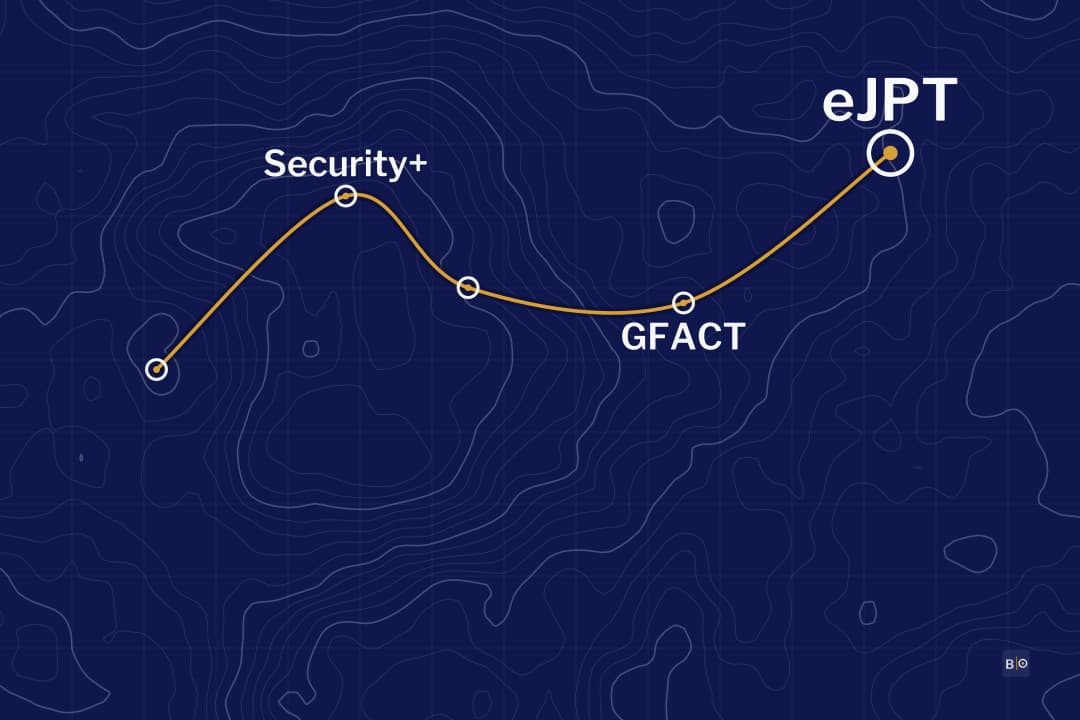
Studying in the evenings, you'll usually run short of time before money. Most certification purchases start a clock: 90 days of lab access in OffSec's OSCP bundle, 120 days from activation for a GIAC attempt, 180 days on an INE eJPT voucher. Some exams also need whole days off work. So choose credentials whose deadlines fit the hours you actually have, and know how ISC2 counts part-time security work before you take any.
The clock each purchase starts
| Credential | Deadline after you pay | The exam itself | Where you sit it |
|---|---|---|---|
| Security+ ($439) | Voucher sold with 12 months' validity; SY0-701 retires June 11, 2027 regardless | 90 minutes | Test center or online |
| GFACT ($399) | 120 days from activation; 45-day extensions can be bought | 2 hours | Online proctored or test center |
| eJPT | Voucher valid 180 days; the free retake must follow within 14 days | 48 hours in a lab | Online |
| BTL1 (£399) | Four months of training access and 100 lab hours | Up to 24 hours | Online, unproctored |
| HTB CDSA ($210) | Voucher valid one year, after a 15-module path | Seven days, report included | Online |
| OSCP ($1,749 bundle) | 90 days of course and lab access | 23 hours 45 minutes, then 24 hours for the report | Online, proctored |
Two kinds of deadline sit in that table. CompTIA's voucher is generous, but its terms say an exam's retirement date overrides the voucher's expiry and that expiry dates can't be extended. A V7 voucher bought next spring can lapse with the exam. The other deadlines measure study time, not booking time. OffSec's 90 days is the period you have the course and labs, and a GIAC attempt's 120 days runs from activation, so don't activate until your preparation is mostly done.
Exams that need annual leave
A multiple-choice exam fits a Saturday morning. The practical ones don't. OSCP takes most of a day plus another day for the report, eJPT gives you 48 hours, and Hack The Box's CDSA runs for seven days, with the incident report due inside the same week. You can spread the eJPT across a weekend. You can't do OSCP or CDSA well around a full working day, so book the leave when you book the exam.
The course windows are tighter than the exams. Our OSCP guide calls the 90-day bundle tight unless you can study most days. OffSec's alternative is Learn One: a year of course access and two exam attempts for $2,749. With ten spare hours a week, we'd budget for the year from the start. BTL1's four months of training access suits a slower pace better, and its exam fits a weekend.
Leave room for a second attempt
Build a failed attempt into the plan, because each vendor's retake rules eat into the same deadlines. CompTIA lets you retake straight away after a first failure but makes you wait 14 days before a third try. GIAC imposes a 30-day wait, and a purchased retake adds 60 days to the attempt, wait included. INE's free eJPT retake has to happen within 14 days of the failed attempt and before the voucher's 180 days run out, so if you sit the eJPT in the last fortnight of its validity, you may lose the retake. For any of these, sit the first attempt with at least a month of the window left.
When part-time work counts as experience
Sooner or later you'll want security work on your record, and ISC2's rules show what counts. For SSCP and CISSP, a month of experience means 35 hours a week for four weeks. Part-time work counts if it's between 20 and 34 hours a week, at 1,040 hours for six months of credit and 2,080 hours for a year. Paid or unpaid internships count too, with a letter on the organization's letterhead.
So a ten-hour weekly side project, however serious, isn't experience in ISC2's terms, while a qualifying 20-hour part-time security role counts at ISC2's published conversion rate. You would need 104 weeks at that schedule to reach 2,080 hours. If you can arrange one, for example by taking on security duties in a part-time IT job or a documented internship, it starts the experience clock while you keep your main income.
ISC2's associate routes also suit a part-time pace. Pass SSCP without the year of experience and you become an Associate of ISC2, with two years to earn it. Pass CISSP without its five years and you get six years to earn them.
A working year, in order
Start with the exam whose clock is longest. Security+ suits that slot: the 12-month voucher leaves room for a slow first pass through the material, and you can sit it online on a weekend. Decide on the version first. SY0-801 is expected to launch on or around November 17, 2026, so anyone starting from scratch now should prepare for it.
Next, add one practical credential in the direction you want to work, timed for a stretch when work is quiet. BTL1 or CDSA suit defensive roles; eJPT suits testing. Hold OSCP until you can either commit most days for 90 days or pay for the longer subscription.
All the while, look for a way to log part-time security hours at your current employer. If you already work in IT, the security tickets in your own queue are the easiest place to start; our IT-to-security route covers how to claim them.
Signs it's time to go full time
No one publishes how long part-time learners take to switch, so judge by readiness rather than the calendar. You're close when you hold one knowledge exam and one practical credential, you can describe a real investigation or test you did step by step, and you have security hours a reference can confirm. At that point an extra certificate adds less than applications do. Readers without an IT job yet should read our route from no experience, and those choosing between paid courses and self-study can compare our self-taught plan.
Sources
-
HTB Academy subscriptions: current student/annual plans and $210 CDSA exam voucher, checked October 2026
-
CompTIA Security+ V7: $439 voucher, 12-month validity, SY0-701 retirement, delivery, checked October 2026
-
CompTIA Security+ V8: SY0-801 launch date, checked October 2026
-
CompTIA Voucher Terms: retirement overrides expiry, no extensions, checked October 2026
-
GIAC Retakes and Extensions: 120-day attempt window, 45-day extensions, 30-day retake wait, checked October 2026
-
CompTIA Certification Retake Policy: retake waits, checked October 2026
-
GIAC GFACT: 2-hour exam, checked October 2026
-
GIAC Pricing: $399 GFACT attempt, checked October 2026
-
INE eJPT certification: 180-day voucher and 14-day retake, checked October 2026
-
Centri: Blue Team Level 1: £399 price, four months of access, 100 lab hours, 24-hour exam, checked October 2026
-
HTB Academy: HTB Certified Defensive Security Analyst: prerequisite path, seven-day exam, report, $210 voucher, checked October 2026
-
OffSec pricing: $1,749 bundle with 90 days, $2,749 Learn One, checked October 2026
-
OffSec PEN-200: Learn One with two exam attempts, checked October 2026
-
OffSec: OSCP+ Exam Guide: 23 hours 45 minutes and 24-hour report window, checked October 2026
-
ISC2 SSCP Experience Requirements: full-time and part-time definitions, internships, two-year associate window, checked October 2026
-
ISC2 CISSP Experience Requirements: five-year requirement and part-time rules, checked October 2026
-
Become an Associate of ISC2: six-year CISSP and two-year SSCP associate windows, checked October 2026