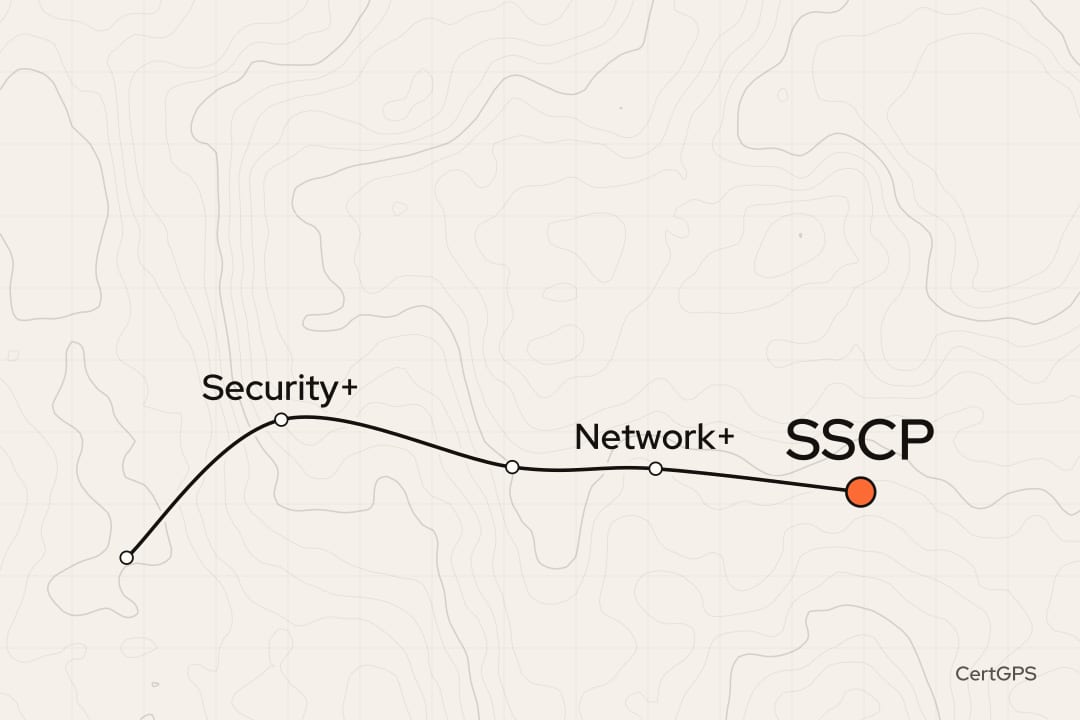
While you're enrolled you can buy exams at academic prices, and a documented internship counts toward ISC2's experience rules. With the right major, the degree itself can stand in for a year of experience, including for a career changer who already holds a qualifying degree. Spend first on what only students can get, and hold the bigger certification purchases until an internship or job offer shows you which one it wants.
What enrollment gets you
CompTIA sells at student prices to people enrolled at a US degree-granting Title IV university, a Canadian university, or a US high school as a junior or senior aged 16 or over. You verify through SheerID, a third-party service, and can then buy two of each exam type and one of each learning product every six months. CompTIA's help pages don't print the discounted price; it appears in the store once you're verified. That covers Network+ and Security+, whose list prices are $399 and $439.
Microsoft offers academic pricing on its certification exams in most countries, India and China excepted. You mark yourself as a student in your Microsoft Learn profile and verify your status before you book. That matters if you're heading for a Microsoft security operations job, where SC-200 ($165 at full US price) is the relevant exam.
Hack The Box Academy has a student plan at $10 a month for anyone who verifies an academic email or proof of enrollment. It unlocks every module up to Tier II, including the SOC Analyst path you must finish before buying the $210 voucher for HTB CDSA, a seven-day practical investigation graded on a written report. For a student who wants proof of hands-on skill, no other practical defensive credential in this article costs less.
Two free or nearly free things matter more than any discount. The National Cyber League runs fall and spring seasons for high school and college students; fall 2026 registration cost $45 (or $55 late), with the individual game on October 23 to 25 and the team game on November 6 to 8. Players get a Scouting Report they can show employers. ISC2 Candidate is free for the first year and $50 a year after, and takes 10% off ISC2's self-paced training. The once-free ISC2 Certified in Cybersecurity exam is no longer free: ISC2 closed that program to new enrollments on May 20, 2026, and CC now costs $199.
Scholarships and internships, with the paperwork that counts
CyberCorps Scholarship for Service (SFS), funded through National Science Foundation grants and run with the Office of Personnel Management, pays for up to three years of cybersecurity study at participating schools. In return you work for the US government in a cybersecurity role for as long as the scholarship lasted. If your school takes part, apply early; it's the largest single offer on this page.
The federal Pathways Internship Program hires students enrolled at least half time, posts openings on USAJOBS, and may let agencies convert an eligible intern to a permanent job without competition. The usual minimum is 480 internship hours, down from 640, alongside completion and qualification requirements; a waiver can reduce the hours to 320. Private internships matter just as much, and ISC2 will count either kind. Its experience rules accept paid or unpaid internships as long as you have a letter on the organization's letterhead confirming the role. Part-time work counts if it's 20 to 34 hours a week, with 1,040 hours equal to six months of full-time experience.
Ask for that letter before the internship ends, while your supervisor still remembers you. For more on what internship postings ask for, see our internship requirements analysis.
Your degree may already be a year of experience
ISC2's SSCP needs one year of security experience, and ISC2 accepts a degree in place of that year if it comes from a cybersecurity program or from one of its preapproved majors: computer science, computer engineering, computer systems engineering, management information systems or information technology. A graduate in one of those subjects can pass SSCP ($249) and, once ISC2 approves the endorsement, hold the full certification rather than the Associate of ISC2 designation. ISC2 lists SSCP as approved under the US Defense Department's DoDM 8140.03 manual, which helps if you're applying to defense contractors.
The same degrees help much later. A bachelor's or master's in computer science, IT or a related field can satisfy one of the five years of experience that CISSP requires.
If you're still choosing a school, check whether it holds a National Centers of Academic Excellence in Cybersecurity designation. The program is managed by the NSA's National Cryptologic University, and its Cyber Defense designation covers associate, bachelor's and graduate programs whose curriculum has been validated against the program's standards.
A plan by year
First year: take the networking and operating systems courses seriously, and play an NCL season. Hold off on exams unless networking is a weak spot and a Network+ deadline would help you study.
Second year: sit Security+ at the student price, timed around the version change. SY0-801 is expected to launch on or around November 17, 2026 and SY0-701 retires in English on June 11, 2027, so a student starting from scratch this fall should prepare for V8. Apply for summer internships, and for SFS if your school participates.
Third year: do the internship and get the letterhead letter. Add one practical credential through the HTB student plan, or a vendor exam at academic pricing if your internship employer runs a particular platform.
Final year: sit SSCP if your major qualifies, so you can hold the full credential soon after graduating. Then stop collecting. A second-year Security+, an internship letter, an NCL Scouting Report and SSCP make a stronger application than five entry-level certificates, and they cost less.
Where we'd disagree with the usual advice
Students are often told to stack as many beginner certifications as possible before graduating. We think that wastes the student advantage. The discounts are welcome, but the opportunities to prioritize while enrolled are scholarships, student competitions and documented internships. Career changers may also qualify if they enroll, and nonstudent internships can count toward ISC2's experience rules too. Spend your time on those first. Graduates who come out without an internship can follow the route from no experience, and the ISC2 certification path shows where SSCP leads.
Sources (20)
- CompTIA: Do You Offer Discounts for Students?: eligible institutions, SheerID, purchase limits, checked October 2026
- CompTIA: Academic Discounts and Purchasing Options: student and institutional pricing routes, checked October 2026
- CompTIA Network+: $399 voucher, checked October 2026
- CompTIA Security+ V7: $439 voucher and SY0-701 retirement, checked October 2026
- CompTIA Security+ V8: SY0-801 launch date, checked October 2026
- Microsoft Learn: Student discounts: academic pricing and excluded countries, checked October 2026
- Microsoft exam pricing data: $165 US price for SC exams, checked October 2026
- HTB Help Center: Academy Subscriptions: $10 student plan and included paths, checked October 2026
- HTB Help Center: Getting the Student Subscription: eligibility and verification, checked October 2026
- HTB Academy: HTB Certified Defensive Security Analyst: $210 voucher, seven-day exam, prerequisite path, checked October 2026
- National Cyber League: eligibility, fall 2026 fees and dates, Scouting Report, checked October 2026
- ISC2 Candidate: free first year, $50 dues, training discount, checked October 2026
- ISC2 One Million Certified in Cybersecurity: program closed May 20, 2026 and $199 fee, checked October 2026
- CyberCorps Scholarship for Service: scholarship length, NSF funding, service obligation, checked October 2026
- OPM: Students and Recent Graduates: Pathways eligibility, 480-hour conversion rule, USAJOBS, checked October 2026
- ISC2 SSCP Experience Requirements: degree pathway, internships, part-time rules, checked October 2026
- ISC2 SSCP: DoDM 8140.03 approval, checked October 2026
- ISC2 Exam Pricing: $249 SSCP registration, checked October 2026
- ISC2 CISSP Experience Requirements: degree waiver, checked October 2026
- NSA: National Centers of Academic Excellence in Cybersecurity: program management and designations, checked October 2026